
Cleanliness, whiteness, and uniform color are basic quality standards for hotel linen. Laundry plants usually face such customer complaints: linen graying and yellowing, poor whiteness, as well as colored linen fading and dye transfer. These quality issues directly affect guest rooms’ appearance, which causes customer loss. Meanwhile, they significantly reduce linen service life. Unlike linen damage, discoloration issues are mainly caused by soil redeposition, water impurities, incorrect chemical dosing, and mixed washing. Traditional standalone manual washing processes fail to address this issue completely.
Kingstar is a one-stop smart laundry system integrator. It features tunnel washer systems, smart rinsing, and automatic compartment washing technology. It has extensive practical experience in hotel linen laundry projects. So it analyzes various causes of linen discoloration issues, dye transfer, and color fading. With equipment and technology advantages, Kingstar develops integrated solutions. It helps laundry businesses maintain linen whiteness as well as avoid dye contamination. This further reduces linen replacement costs.
Core Causes of Linen Graying, Yellowing & Poor Whiteness
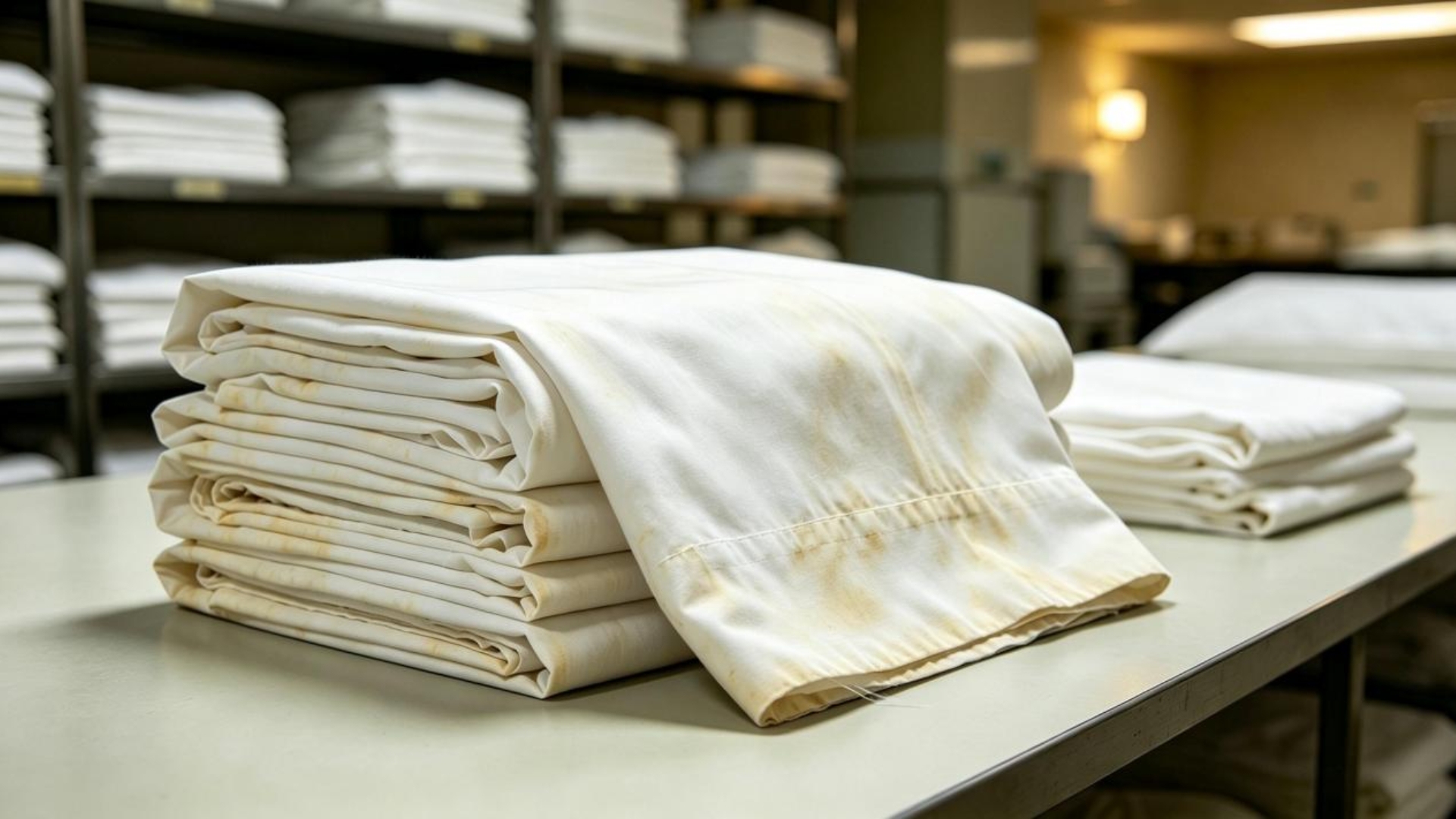
● Overall graying and dull appearance
Stains cannot be removed completely, which causes soil redeposition.
When the water hardness is excessive, calcium and magnesium ions combine to form calcium soap deposits. They hide in fiber gaps and continue to accumulate.
The rinsing water level is insufficient, and the rinse cycles are inadequate. Water flow cannot remove dust particles and oil residues.
After many wash cycles, residual impurities, sediment particles, and pigments still remain. So, linen turns gray and dull.
● Linen yellowing & localized yellow stains
This is due to chemical residues and water impurities. Excessive iron ions lead to overall linen yellowing.The chlorine bleaching rinse is incomplete. So chlorine residues cause fabric oxidation. Undiluted softener directly contacts linen. This forms localized yellow stains. Besides, residual alkaline agents may remain on fabrics. Protein stains are processed with chlorine bleach. This leads to oxidation and yellowing over time. Excessive optical brighteners result in uneven whitening as well as dull appearances.
● Yellowing after bleaching & substandard cleanliness
Some fabrics are sensitive to chlorine bleach. Meanwhile, yellowing after bleaching is usually caused by excessive bleach concentration and insufficient rinsing. Pigments cannot be thoroughly broken down. Simplified rinsing processes result in residual impurities, which directly reduce linen whiteness.
● Abnormal color residues
Chili oils and skin care colored stains are decomposed incompletely. Rust stains are not deeply bleached. Pigments adhere to fabrics for a long time. Bleaching temperature and time, as well as chemical concentration, do not meet the standards. Pigments cannot be thoroughly broken down. Impurities in water are excessive. Free pigments are adsorbed onto fabrics again, which forms stubborn color stains.
Causes of Colored Linen Color Fading & Dye Transfer
Large-scale dye transfer losses of colored linen may cause significant cost losses for laundry plants.
● Incorrect chemical dosing
Colored linen is treated with strong oxidizing chemicals, such as chlorine bleach. This directly damages colorfastness, causing large-area color fading.
● Excessive process parameters
Excessive water temperature and excessive water alkalinity accelerate dye release.
● Nonstandard operations
Blend dark and light-colored linens. Dyes spread in water, resulting in large-scale dye transfer.
● Fabric & water quality
The linen itself has poor colorfastness. Hard water quality accelerates dye release.
Drawbacks of Traditional Standalone Washing Process
Workers cannot control rinsing water levels and cycles. After washing, chemicals still remain. Dust continuously accumulates. So, linen gradually turns yellow.
Washing processes lack proper color separation. Dark and light-colored linen is mixed. It is more likely to cause dye transfer.
Chemical dosing completely relies on experience. Improper dosage of bleach, softener, and optical brightener triggers yellow stains and uneven colors.
Water quality cannot be adjusted in time. Calcium and magnesium soap continues to deposit in hard water. Repeated washing makes linen more gray.
Kingstar Smart Laundry Solutions
● Dual-compartment counterflow rinsing
Kingstar tunnel washer uses a counterflow rinsing technology. Clean water flows in reverse to flush the linen step by step. This significantly improves the cleaning efficiency of impurities and chemical residues. Automatic water softener dosing helps neutralize calcium and magnesium ions in water. This avoids calcium soap deposits. So linen graying issues can be solved at the source.
● Precise chemical dosing
The system has a built-in hotel linen washing program. It can automatically choose the proper chemical dosage (bleach, softener, and neutralizing agent). This avoids bleach residues and localized softener buildup. Chemical formulas depend on different linen types. Colored fabrics are prohibited from chlorine bleaching programs. This protects fabric colorfastness from color fading.
● Standard bleaching processes
The system has bleaching programs for white bedding and towels. This precisely controls bleaching temperature, chemical concentration, and processing time. So linen yellowing by excessive bleaching can be avoided. A heat energy recovery constant-temperature system ensures stable bleaching parameters. Various colored stains can be broken down completely. It also maintains linen long-term whiteness.
Daily Operating Suggestions
In hard water areas, laundry plants should install soft water treatment equipment. Regularly maintain a linen restoration treatment to clean long-term calcium soap deposits.
Strictly wash the linen separately by color. Do not process dark and light-colored linen in the same compartment.
Colored linen should be processed with oxygen bleaching. Do not use chlorine bleach.
Choose automatic tunnel washer systems. Replace manual operations with standard washing processes.
Conclusion
Linen graying, yellowing, color fading, and dye transfer all result from a lack of standardized washing processes. Traditional standalone manual mode fails to stably control chemical dosing, water quality, and sorting. Kingstar smart laundry equipment addresses various color issues in a one-stop solution. At the same time, it provides integrated planning and design services for smart laundry plants. Therefore, global hotels and large-scale laundry plants can build automated laundry production lines, which are low-consumption, high-quality, and low-cost.
Q&A
Q1: Why does large-area color fading occur on colored linens after washing?
A1: Misuse of chlorine bleach, excessive washing temperature, excessive water alkalinity, or mixing dark and light-colored linens. Smart equipment can set dedicated non-chlorine bleaching programs for colored fabrics. It also supports compartment washing.
Q2: Linen has localized yellow stains after washing. What chemicals are improperly used?
A2: Undiluted softeners directly contact linen. Incomplete chlorine bleaching causes chemical residues. These two situations cause yellow stains. A smart dosing system automatically dilutes and properly doses chemicals, which effectively avoids the above issues.
Q3: Compared with traditional rinsing, what are the advantages of dual-compartment counterflow rinsing to improve linen whiteness?
A3: Water in the front compartment cannot flow back. So, rinsing cleanliness is improved. It also greatly reduces residual detergents and calcium soap deposits. After long-term use, linen is less likely to accumulate dust and turn yellow. Meanwhile, the linen water consumption per kilogram can be controlled at around 4.7-5.5 kg, which ensures linen quality and energy efficiency.
Post time: Aug-20-2026