
Laundry plants have long operated independently. Regardless of size, opening a laundry plant requires steam supply systems, wastewater management, operating licenses, and environmental compliance measures. Each of them requires significant investment and effort.
Nowadays, environmental protection policies are becoming increasingly strict. Urban land-use planning continues to evolve. Many laundry plants face unexpected situations, such as relocation and shutdown. Once the business is suspended, hotel linen cannot be delivered on time. Hotel operations will be affected. Laundry plants may be liable for compensation. Finding a new facility location is also a difficult problem. Plants have strict requirements for facility location, ceiling height, wastewater treatment capacity, and steam supply. Proper locations are hard to find.
Under such an industry context, a laundry industrial park model emerges. It provides a new development direction for most laundry plants.
Chinese Laundry Industrial Parks
● Maanshan, Anhui Province
A laundry industrial park, located in Maanshan, Anhui Province, is a typical representative of centralized management. This park houses more than ten laundry plants. It covers traditional outsourced linen washing services and linen rental services, which meet the needs of various hotels. Park operators supply centralized heat to ensure stable steam pressure. At the same time, they are responsible for centralized wastewater treatment to meet environmental protection requirements. Laundry plants do not need to expend their energy on affairs like steam, wastewater drainage, and operating permits. They can invest more resources in business expansion, quality improvement, and service upgrade. This helps significantly reduce management costs.
The park also has comprehensive supporting facilities, including fitness rooms, reception areas, entertainment areas, conference rooms, and staff dormitories. It is equipped with centralized warehouses and water softening areas. All laundry plant spaces can be utilized more completely. Business management becomes more convenient. When facing unexpected situations, flexible allocation areas play an important role. This avoids chain reactions caused by a single plant shutdown.
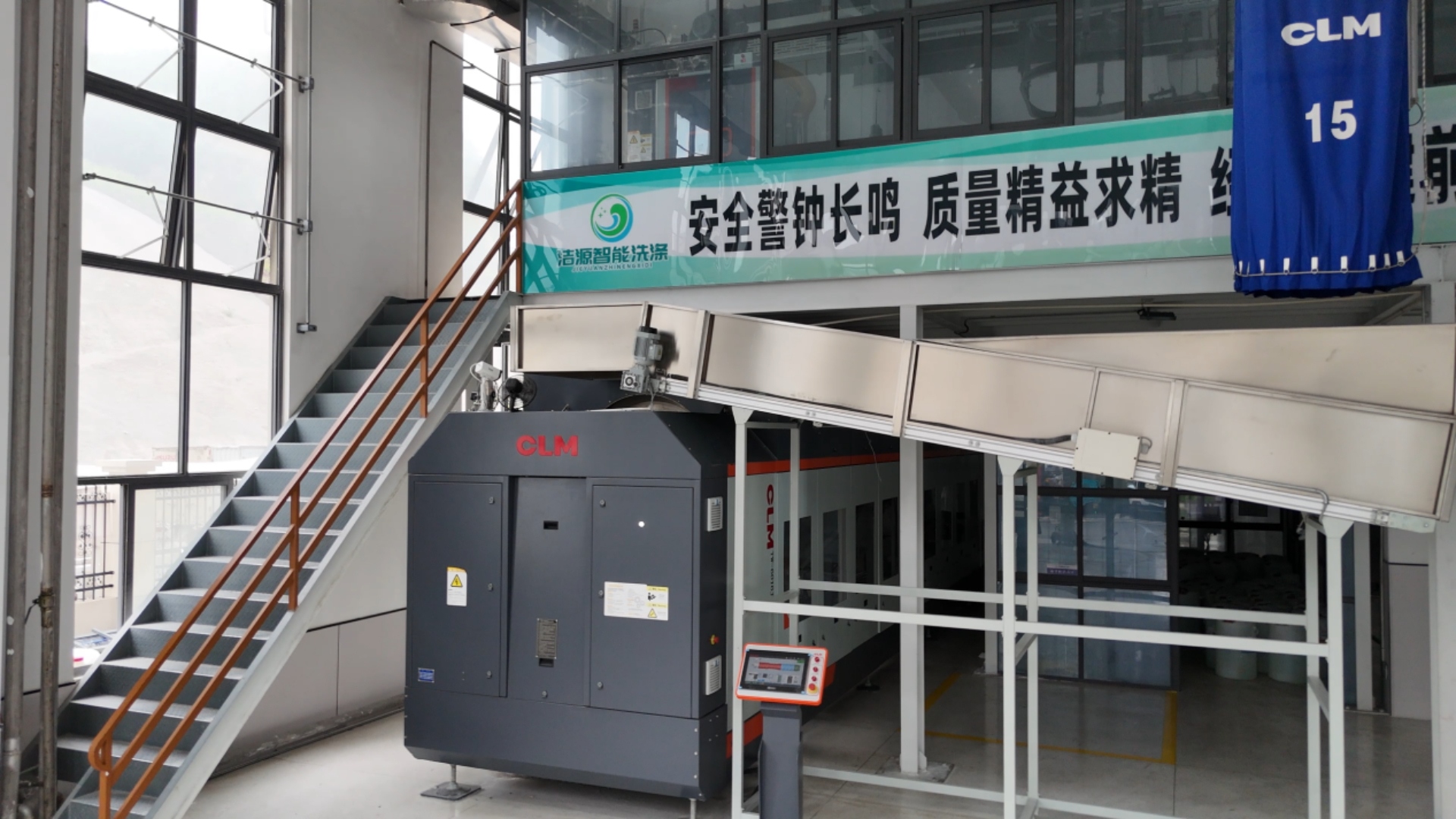
Kingstar takes part in the design and planning of many laundry plants in the park. Jieyuan Laundry is a typical example. This laundry plant provides linen laundry services for hotels, bath centers, and clubs in Maanshan, Anhui Province. The plant has a two-story facility layout. Its laundry equipment comes from Kingstar. All areas are connected by 40 front overhead bags and 40 rear overhead bags. This forms an efficient automatic linen conveying system. After entering the plant, linen is sorted and sent into the tunnel washer by front overhead bags. After washing, they are sent into the pass-through dryer on the second floor for drying and loosening. Dryers are on the second floor, which saves space for the first floor. The working environment is more comfortable for workers on the first floor. After drying, linens are transported to various finishing zones. This design greatly reduces the use of linen carts. Fixed workstations improve operational efficiency, which reduces workers’ workload.
Jieyuan Laundry serves as an example for the other laundry plants. Kingstar communicates with many laundry owners in the park. They believe that the laundry park model is more convenient for everyone. Centralized steam supply and wastewater treatment lower operational costs. Laundry plants spend more time on management, quality control, and business expansion.
Maanshan laundry industrial park is not the only one. At present, many similar laundry industrial parks have been in operation in China. Each of them has developed a distinctive centralized management model.
● Linzhi, Tibet
Bayi District has invested 15 million RMB in building a laundry industrial park. The park covers about 26,000 square meters. It was put into use in October, 2023. There are five linen laundry companies in Bayi District. Most are located in urban-rural fringe areas, which are small and scattered. The market is disordered, while the unhealthy competition is fierce. After park completion, six laundry plants joined in collectively. This completely addresses the past issues. These factories expand their areas from 800 to 2,000 square meters. They use advanced equipment to improve production efficiency. The park also builds unified infrastructure, including water, electricity, steam, and wastewater treatment. This reduces businesses’ costs of building infrastructure independently. It also relieves the pressure of public service supplies.
● Xichang, Sichuan Province
The total investment of the laundry industrial park exceeds 120 million RMB. The total area covers 42 acres. The total building area covers 30,000 square meters. This project went into operation in August 2023. 11 laundry companies have joined in, including 9 linen and towel laundry plants. They process 14,000 linen sets daily. The park has achieved centralized and standardized management of the laundry industry. The past disordered situation has been fundamentally changed.
● Sanya, Hainan Province
Sanya Environment Agriculture Linen Laundry Park covers an area of 50.8 acres. The planning investment is 161 million RMB. The modern linen laundry park has a daily processing capacity of 150,000 pieces. The park creates a two-stage environmental protection model “business pre-treatment + park centralized treatment”. It also builds a wastewater treatment station. Hot steam is supplied by a waste-to-energy plant to achieve energy recycling.
● Fuzhou, Fujian Province
Fuzhou Yinglilai Intelligent Laundry Industrial Park plans to invest 500 million RMB. It covers an area of 43.69 acres. Steam waste heat from China Tianying Company is reused in washing, ironing, and drying processes. This achieves effective use of energy. After operation, the annual output value is expected to reach 300 million RMB. More than 300 positions are created. The park focuses on the core model “centralized layout, smart investment, and green operation”. It is promoting Fuzhou laundry industry towards a green and centralized development.
International Laundry Industrial Parks
In the world, centralized and park-based management is also a critical trend in the laundry industry.
● India
Central Linen Park Private Limited (CLPPL) is the biggest professional hotel linen laundry center in India. Laundry facilities cover an area of 65,000 square feet. Its daily processing capacity reaches 60 tons. The park uses advanced imported equipment. It achieves linen delivery within the required time through its own logistics system. This model provides efficient and stable support for rapid growth in India’s hotel industry.
● Europe
Berendsen is a textile service company that was established in 1854. It has 127 branches in 15 European countries. Through centralized management and standardized processes, it has reduced water consumption by 22% in over 100 commercial laundry plants.
Elis is another French multinational textile service group. It has more than 10 industrial laundry plants in Europe. It provides professional services for large-scale linen users, such as hotels and hospitals. This group has invested 6 million euros in building a plant in Barcelona, Spain. 20% of clean energy is supplied by solar panels on plant roofs.
These European business practices reflect that the centralized and large-scale laundry operational model has been verified worldwide.
Conclusion
From Maanshan to Linzhi, Xichang to Sanya, Fuzhou to Europe, laundry industrial parks have been recognized by more and more areas and practitioners. It addresses the “independent operation” issues in traditional plants — unstable steam supply, substandard wastewater drainage, frequent relocation, high management costs. Through centralized steam heating supply, wastewater drainage and management, laundry plants can be relieved from administrative and logistics tasks. They can devote energy to core businesses.
For the linen laundry industry, the industrial park is not only a business model upgrade, but also a shift in development concepts. In the past, every laundry plant was an island. They independently faced various challenges in policy, environmental protection, and markets. Nowadays, they integrate together through park models. This achieves resource sharing, complementary advantages, and risk sharing. As the Maanshan laundry industrial park, laundry plants do not need to worry about steam supply, wastewater drainage, and location selection. They can develop with reliable quality and services.
Centralized management makes industrial laundry plants more worry-free worldwide.
Q&A
Q1: Jieyuan Laundry uses 40 front overhead bags and 40 rear overhead bags. What is the laundry capacity?
A1: 4,000 to 5,000 linen sets.
Q2: What is the specification of Kingstar overhead bags?
A2: The front overhead bag is 60 kg. The rear overhead bag is 120 kg.
Q3: Do plants in the laundry industrial park compete with each other?
A3: Laundry plants may vary in their customers. Some are specialized in linen rental. Some focus on outsourced linen washing services. Some also have regular customers. They join the park for centralized management, steam heating supply, and wastewater drainage. This reduces the difficulty in laundry plant management.
Post time: Aug-14-2026