
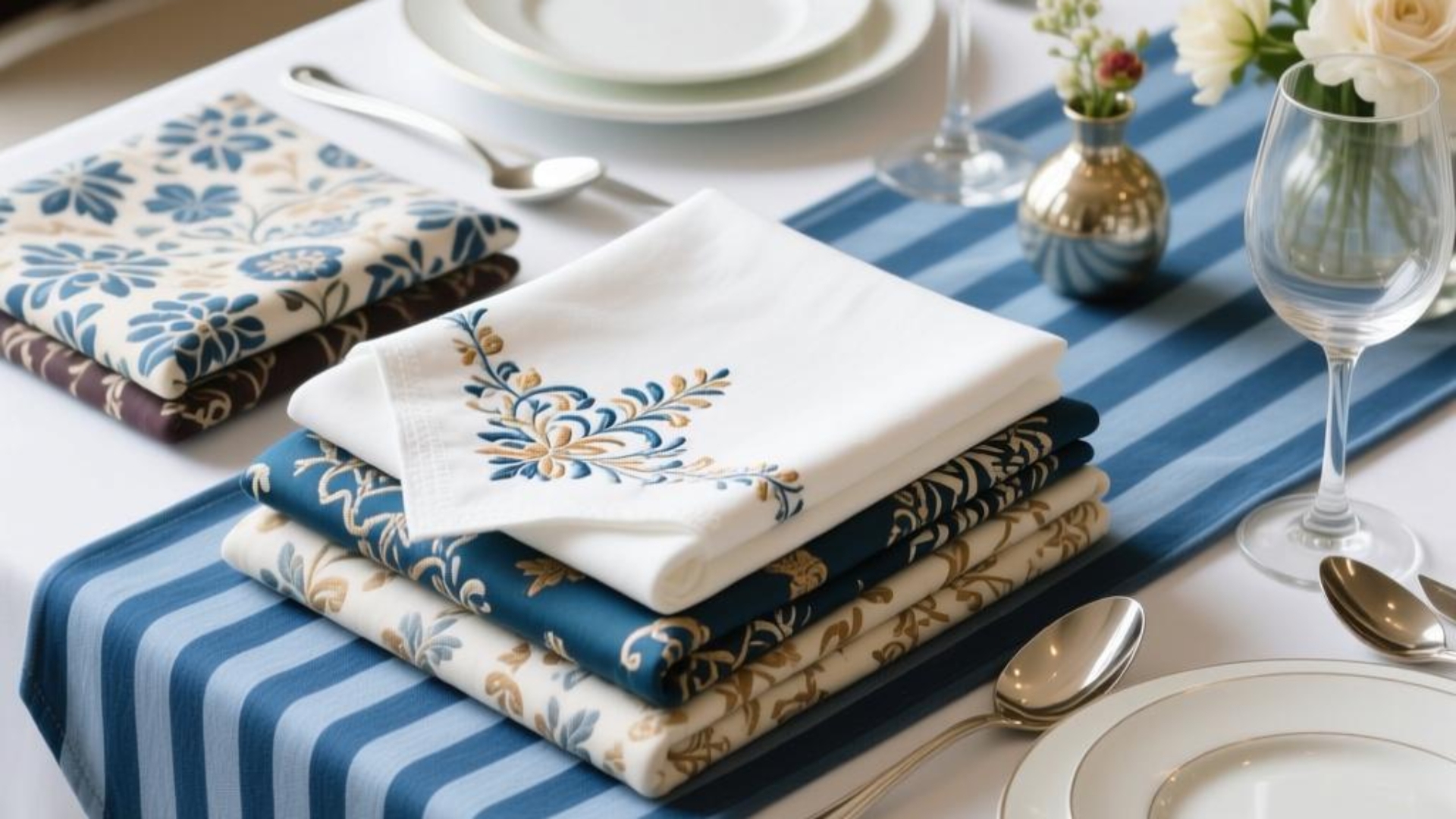
In the hospitality industry, clean and crisp linen is the first quality business card that a restaurant presents to its customers. However, behind this business card, there are severe challenges that the laundry factory faces every day. Oil stains, wine stains, pigment, and high-frequency washing together test the lifespan of the linen and the professional capabilities of the laundry factory.
For laundry plants, the catering linen business is a stable profit. People should achieve a precise balance between cleanliness, hygiene, lifespan, and operating efficiency. This is not only a technology. It is a complete system from scientific knowledge to refine management.
Core Challenge
The difficulty of cleaning catering linen is much greater than that of other hotel linen. Its speciality determines the complexity of the washing process.
● Compound stains
It is a mixture of animal and vegetable oils, proteins (bloodstains, eggs, milk…), tannins (tea, wine…), pigments, and seasonings, so it needs to be treated separately.
● Hygiene
It must meet the relevant national hygiene and disinfection requirements and prevent cross-contamination from food.
● High turnover and high loss
The linen in restaurants is frequently changed, but frequent and powerful washing accelerates the aging of fibers and color fading.
● Cost control pressure
Linen is an important asset for restaurants, and the quality of washing directly determines its service life. Every 1% reduction in the rewash rate and every extended cycle of linen life can bring economic benefits to laundry factories and restaurant customers.
Key for Success
To deal with these challenges, depending on scattered experience or a simple and crude way of washing is not feasible. Successful laundry factories have shifted to relying on a full-process management system composed of standardized procedures, precise material management, and intelligent equipment.
Stage 1
High-efficiency treatment is the key to improving the overall laundry quality, reducing the rewash rate, and protecting the subsequent equipment.
● 3-level classification
- Material
Cotton, polyester-cotton, and chemical fiber must be treated separately.
- Color
White, light, dark, and colored linen should be strictly sorted. When treating colored linen, people should avoid using chlorine bleach and special color-fixing agents, and color bleach powder must be used instead.
- Level of dirt
Mild contamination, severe oil stains, and special stains (red wine and curry) should be treated separately to facilitate the setting of different washing programs.
● Fixed-point pretreatment
Spray a special heavy oil emulsifier or enzyme pre-coating agent on the heavily oily area (such as the center of the tablecloth) → stand for 5 to 10 minutes → fully decompose the oil → greatly reduce the difficulty of the main wash.
Stage 2
The washing and disinfection process should be precisely controlled.
● Pre-wash
Using a low water level, cold water, or warm water is not for removing dirt. It is for wetting the fibers, washing away loose dirt, and creating conditions for the main wash. Adding a small amount of alkaline agents can initially soften the oil.
● Main wash
- Temperature
Natural fibers (pure cotton, linen…) can be treated with high temperatures (75-85℃) and strong alkaline detergents to achieve great decontamination and disinfection.
For fabrics made of chemical fibers or elastic fibers, the temperature must be controlled below 50-60℃ to prevent wrinkling and setting.
- Golden Triangle of chemicals
The main washing effect depends on alkalinity, temperature, time, mechanical force, and chemicals. For catering linen, a powerful emulsifier is a must. It can break down oil stains into water-soluble particles. Also, a strong laundry detergent/liquid should be used in combination to provide the necessary alkalinity and decontamination power. For large-scale and high-efficiency laundry plants, the adoption of a tunnel washer system can precisely control the water level, temperature, time, and chemical material input of each chamber. This achieves standardization and optimization of the washing process.
● Rinse and neutralization
- Sufficient rinsing
The CLM tunnel washer system has a genuine counter-current rinsing structure design. It adopts a counter-current rinsing at the bottom of the double-compartment so that water from the front chamber won’t flow to the rear chamber. This effectively ensures the rinsing effect and significantly reduces the residue of detergents and impurities. In areas with high water hardness, soft water should be used, or scale inhibitors should be added to prevent calcium soap deposition from causing the linen to turn gray and hard.
- Key neutralization
The linen after the main wash is alkaline. An acidic neutralizer must be used. pH value 5.5-6.5 is close to the pH level of human skin and can dissolve the remaining alkali and metal ions.
● Functions
- Sizing
It can be used for restoring the crisp texture of napkins and tablecloths. The concentration of the slurry powder needs to be precisely controlled.
- Softness
The yellow variant softener can improve cotton linen handle, but the dosage should be proper to prevent water imbibition and a greasy feeling.
● Deep disinfection
- Thermal disinfection
It is the most reliable method. Washing at a temperature above 80℃ for more than 10 minutes can kill the vast majority of pathogenic microorganisms.
- Chemical disinfection
For linen that is not heat-resistant, chlorine-containing disinfectants (with an effective chlorine concentration of 200-250 PPM at 40℃) or peroxic acid disinfectants can be used. The dosage and action time need to be precisely controlled. Thorough rinsing must be carried out after disinfection.
Stage 3
The post-wash finishing directly affects the delivery status and storage lifespan of the linen.
● Dewatering and ironing
High-efficiency dewatering is the basis of quick ironing and energy saving. The press in the CLM tunnel washer system can reduce the moisture content to around 50%. The following high-speed ironing line can not only make linen flat, improve efficiency, but also avoid yellowing caused by overheating with its precise temperature control and pressure system.
● Scientific storage
- Linen must be folded and stored after being completely dry.
- The storage environment should be cool, dry, and well-ventilated.
- People should use shelves or trolleys and avoid direct stacking on the ground.
Q&A
● Q1: Why is it difficult to clean the heavy oil stains on catering linen, and why do they easily get damp again?
A1: Catering grease (animal fat) cools down and penetrates deep into the fabric.
It is partially broken down when the washing temperature is low or the alkalinity is insufficient.
It accumulates and attracts dust during storage.
● Q2: How to balance disinfection effectiveness and safety for catering linen, and how to avoid chemical residue?
A2: Thermal disinfection is best.
Cotton can be washed at more than 80°C for at least 10 minutes to achieve complete disinfection.
Standard chemical disinfection is suitable for heat-sensitive linens. Complete rinsing is required after the process.
An acidic neutralizer is used to adjust the linen pH to 5.5-6.5, which removes residual chemicals and prevents yellowing.
● Q3: How to keep linen clean and effectively extend its lifespan at the same time?
A3: Linen is sorted by soil level to avoid unnecessary over-washing of lightly stained items.
The use of chlorine bleach is limited. People should use oxygen-based bleach.
Chemical dosages are accurately controlled to prevent excess application during the washing process.
Excessively high temperatures are avoided during drying and ironing to protect the fabric fibers.
A water softening system should be used.
Post time: Jan-30-2026