
As an important auxiliary supply in hospitals, the quality of medical linen’s laundry and disinfection directly affects the health of the medical staff and patients and the effectiveness of the hospital’s infection prevention and control. To further push the standardized development of the medical linen laundry industry and clarify industry operation standards, this article collects the standards of core tests and the steps of key treatment as a professional preference for industry practitioners and medical institutions.
Strengthen the Foundation of the System
The top task is to establish a complete and professional management system. Medical institutions and laundry companies should establish an institutional system that can cover the many dimensions on the basis of the entire life cycle of the laundry and disinfection of the medical textiles.
The system specifically includes:
- Medical fabric washing and disinfection work process system
- Classified collection management system
- Washing and disinfection hygiene quality monitoring and inspection system
- Clean fabric storage management system
- Safety operation system
- Equipment and environmental hygiene cleaning system
- Job responsibilities and occupational protection system for practitioners
Systematic institutional construction can ensure that rules regulate every operation link. This guarantees the quality of medical linen washing from the source.
Strengthen the Protection
The laundry industry practitioners are the core operators of the medical linen laundry tasks. Their personal protection not only concerns their health but also effectively avoids cross-infection. During the operation, people should strictly follow the protective requirements.
● Dress code
Staff should keep their dress neat and change their work clothes regularly. It is strictly prohibited to wear slippers on duty, and one must not enter the dining area, meeting area, or leave the workplace in work clothes.
● Protective equipment
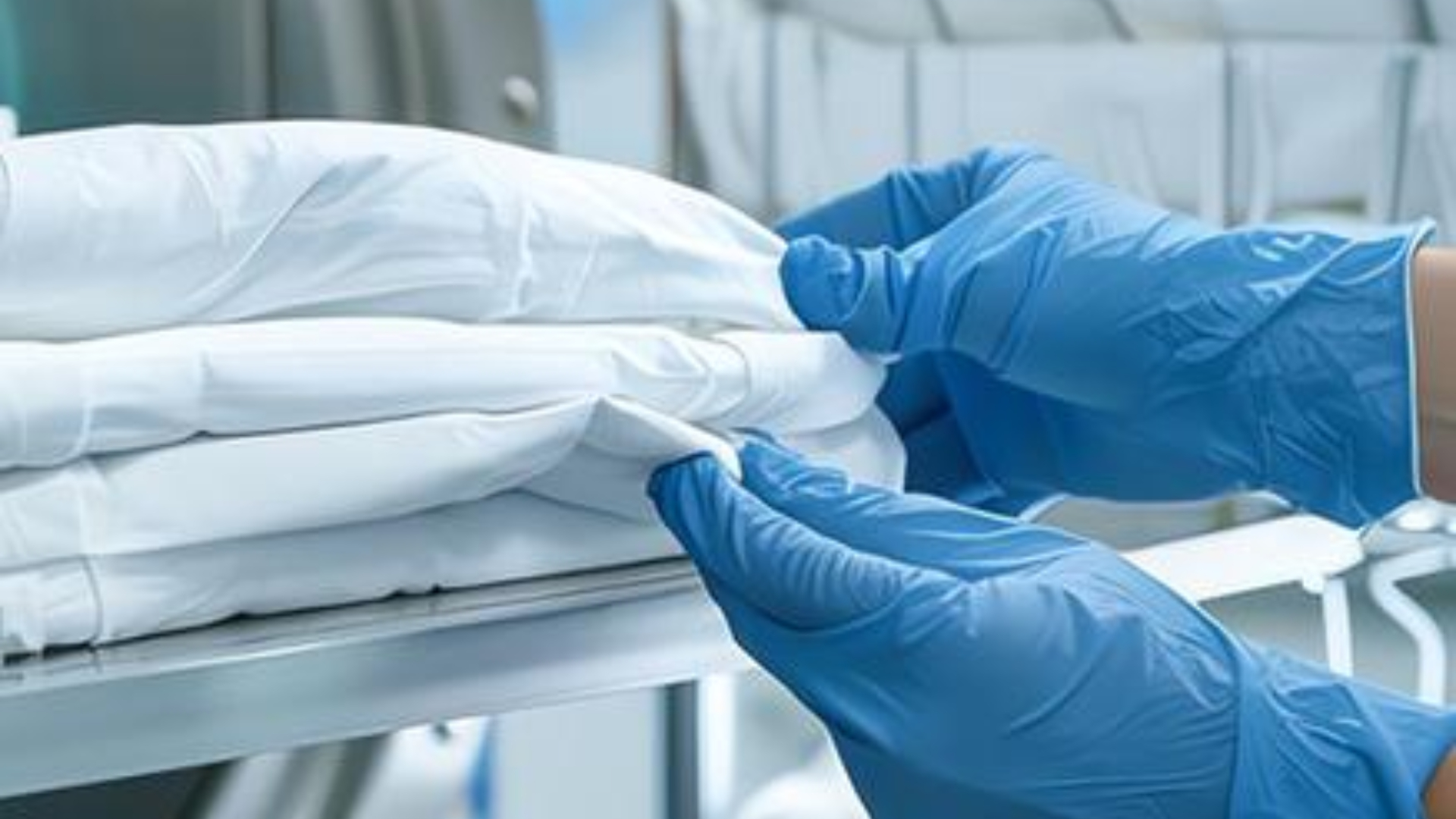
When collecting dirty linen and distributing clean linen, it is necessary to wear protective gloves, masks, and hats properly and wear special work clothes to fully block the contact routes of pollutants.
● Hygienic management of hands
Staff should keep their hands clean at any time, so they should wash their hands or disinfect their hands according to standard procedures to remove the risk of hand transmission and infection.
Scientific Classification and Disposal
There are many kinds of medical linen, and their contamination levels and infection risks are different. Scientific classification is the key link for avoiding cross-infection.
● Normal soiled linen
Staff should collect soiled linen at the designated location. Linen should not be sorted in hospital corridors, passageways, and other public areas. After collection, the soiled linen should be put in the concealed container and delivered by the special line. The linen should follow the rule of “dirty to clean” and avoid going back. Also, the conveying container and vehicles for clean linen and dirty linen should be clearly distinguished and marked. After usage, instant cleaning and disinfection should be done.
It is strictly prohibited to conduct inventory operations in public areas such as hospital corridors and passageways.
● Special soiled linen
Linen that has been contaminated by blood or body fluids and clothes used by infectious disease patients should be placed separately and sealed in double-layer packaging bags. Clear contamination labels should be marked on the outside of the packaging bags for special treatment in the future.
● Requirements for classified storage
Staff’s clothes, patients’ clothes, and bedding, special linen for operating rooms should be clearly classified, and mixed storage should be strictly avoided.
Clean linen, contaminated linen, and other related items should be placed in separate areas and by category to remove the possibility of cross-contamination in terms of space.
Optimize the Hygiene of the Environment
The environmental hygiene of the washing site is an important premise of the
The environmental hygiene of the washing site is an important prerequisite for ensuring the quality of medical linen washing. It is necessary to strictly implement the hygiene and disinfection system. The specific requirements include:
● Daily cleaning and disinfection
Set a fixed day for cleaning the working environment every week. On weekdays, the windows should be open regularly to ensure good circulation. The contaminated area should be disinfected by the UV lights every day, and wet cleaning and disinfection should also be done twice a day.
All disinfection operations should be recorded in detail to ensure traceability.
● Management of Cleaning Tool
The cleaning tools for different zones should be used separately. Tools such as rags and mops should be classified, disinfected, soaked, and stored in fixed locations.
The zone mark should be clear to avoid cross-contamination caused by the mixing of the tool.
Standardize the Laundry Process
The process of laundry and disinfection is the core to determining the quality of the medical linen. Staff should strictly follow the scientific operation rules and processes to ensure that the cleanliness and disinfection of the linen meet the standards.
● Partial stains
When treating the partial stains of the linen, people should follow the professional rules of “dry first, then wet” and “ alkali first, then acid” to avoid residual stains or damage to the linen caused by the improper treatment methods.
● Disinfection process of the textiles
According to the level of contamination and risk of infection, staff should use differentiated cleaning and disinfection processes.
- Normally contaminated textiles:
Clean to remove surface dirt → disinfect by washing with 250mg/L chlorine-containing disinfectant for at least 10 minutes → rinse and neutralize thoroughly to eliminate disinfectant residue on linen.
- Obviously contaminated textiles:
For those with visible blood, bodily fluids, secretions, or excretions:
Remove visible contaminants via washing → disinfect by washing with 2000mg/L high-concentration chlorine-containing disinfectant for 30 minutes → rinsing → neutralization.
- Highly contaminated textiles:
For those contaminated by gas gangrene pathogens, blood-borne pathogens, unknown emerging infectious disease pathogens, mycobacteria, bacterial spores, or multidrug-resistant organisms (MDROs), follow the strict “disinfect first → clean → re-disinfect” process.
use 2000mg/L chlorine-containing disinfectant for ≥30 minutes → clean → disinfect again to minimize infection risks.
Clarify the Quality Standard
The microbial indicators of cleaned textiles are important for measuring laundering quality. They must strictly comply with the following standards.
- Cleaned textiles should be kept dry, clean, and intact.
- Coliforms and Staphylococcus aureus must not be detected in microbial tests.
- The total bacterial colony count shall be controlled within the range of ≤200 cfu/cm².
These requirements ensure that every piece of medical linen meets the standards for safe use.
Professional Parameter Preference
To further improve the accuracy and standardization level of medical linen washing, the key operation parameters of the industry are sorted out as follows for the reference and implementation of practitioners.
Classification and Treatment Methods of Hospital Linen
|
Classification |
Contamination Characteristics |
Washing Key Points |
Detergents Used |
Remarks |
| Surgical gowns, dressing & hemostatic linen | Mainly blood stains and human secretions | Blood removal, disinfection and decontamination | Special detergent for surgical gowns, dedicated blood stain remover | |
| Patient gowns, infant clothing | Mild sweat stains, occasional blood stains | Decontamination, disinfection & antibacterial treatment | Antibacterial Softener | If the washing volume is small, it can be combined with other categories, but must be separately post-treated |
| Doctors’ work uniforms | Heavy sweat/oil stains (collars & cuffs) + various medicine stains | Decontamination, disinfection & antistatic treatment | Antistatic Softener | For non-removable medicine stains, treat individually with special agents during the folding stage |
| Regular Bedding (Sweat Stains) | Mainly sweat stains & human fat-based dirt | Decontamination, disinfection | Dedicated blood stain remover, neutralizer | |
| Bedding (Blood Stains) | Mainly old dried blood stains | Blood removal, decontamination & disinfection | Blood stain remover, neutralizer | |
| Miscellaneous items | Dust, dirt, sand | Decontamination | Regular laundry detergent |
Washing Temperature & Time Chart
|
Temperature |
Time |
Notes |
|
70°C |
25 minutes |
The washing time starts after the specified temperature is reached, and this temperature must be maintained for the entire duration. |
|
75°C |
20 minutes |
|
|
85°C |
15 minutes |
|
|
90°C |
10 minutes |
Doctor’s Workwear Laundering Procedure Chart
|
Serial No. |
Procedure |
Water Level |
Temperature |
Time (min) |
Additives |
Notes |
|
1 |
Load Garments |
|||||
|
2 |
Pre-Wash |
High |
Room Temp |
3 |
||
|
3 |
Add Detergent |
Low |
Room Temp |
Special Detergent |
||
|
4 |
Add Detergent |
Low |
Room Temp |
15 |
Special Disinfectant Detergent |
Add via the additive port |
|
5 |
Main Wash |
Low |
65°C |
75 |
||
|
6 |
Cool with Cold Water |
High |
<45°C |
5 |
Do not spin-drain at high temperatures |
|
|
7 |
Spin-Drain |
3 |
||||
|
8 |
Rinse |
High |
Room Temp |
3 |
||
|
9 |
Rinse |
High |
Room Temp |
3 |
Neutralizer (50g) |
For semi-automatic machines: rinse 5 times; neutralizer dosage: 300g~500g |
|
10 |
Rinse |
High |
50°C |
3 |
Softener (200g) |
|
|
11 |
Medium Spin |
|||||
|
12 |
Unload |
Do not use high-sp |
Water Temperature & Detergent Reference Chart
|
Procedure |
Water Level |
Temperature |
Time (min) |
Add Detergent |
Notes |
| Load Surgical Gowns |
4. For baby clothes and patient gowns, replace the 2nd and 3rd cycles with pre-wash |
||||
| Remove Blood Stains |
High |
Room Temp |
5 |
||
| Remove Blood Stains |
High |
Room Temp |
5 |
||
| Add Detergent |
Low |
Room Temp | Special Detergent | ||
| Add Detergent |
Low |
Room Temp | Special Disinfectant Detergent | ||
| Heat |
Low |
85°C | |||
| High-Temp Wash |
Low |
85°C |
35 |
||
| Medium Spin |
3 |
||||
| Rinse |
High |
Room Temp |
3 |
||
| Rinse |
High |
Room Temp |
3 |
Antibacterial Softener (200g) | |
| Rinse | |||||
| High-Speed Spin |
3 |
||||
|
Unload |
Conclusion
The standardized development of the medical linen laundry industry is an important part of the establishment of the medical health service. In the future, we expect that institutions in the laundry industry should strictly follow the standards and continuously improve the level of washing and disinfection technologies. We should safeguard the health and safety of the medical staff and patients.
Post time: Dec-12-2025