
Why is it so hard to find the truly intelligent laundry plants in China, a land with the world’s largest industrial production capacity? According to CLM’s observation, this is not due to the lack of technologies or money. It is the systematic problem caused by misalignment of industry ecology, thinking patterns, and market roles. In this article, we will focus on the first mile of the intelligent transformation road. Who will lead the planning?
The birth of an intelligent laundry plant starts from the top-level design. However, who should lead the planning? Is it the laundry plant owner or the laundry equipment supplier? The reality is that the cognitive gap and role absence between the two have jointly led to the “inherent deficiencies of the project.
Laundry Plants
The initiative for intelligent transformation lies first in the hands of the investors of the laundry plants. However, their experience of success and thinking model always becomes the first barrier to transformation. Most bosses of laundry plants were sales representatives or managers before. Their success relies on the current process. As a result, their improvement approach is often point-based. They can see that a certain link can add a conveyor belt to save manpower. However, they find it difficult to systematically conceive a digital logistics system that seamlessly connects the entire process from dirty linen reception, intelligent sorting, automated washing, efficient post-treatment, to intelligent warehousing and shipping.
The deeper reason is that it is cost-oriented instead of efficiency-oriented thinking. What investors pursue is the availability and short-term energy saving of individual equipment. They do not have enough value evaluation of the invisible “overall process planning”, “software system integration”, and “optimal solution for long-term operational efficiency” is insufficient.
Laundry Equipment Supplier
When customers cannot express their deep requirements, the leaders of the laundry industry should be taken by the equipment and solutions suppliers. However, the truth is that most laundry equipment manufacturers in China are still trapped in the traditional mode of selling products. Their sales team hasn’t completed the transformation into a project consultant and chief planner.
They may not completely understand customers’ ultimate requirements for cost reduction, efficiency improvement, quality increase, and transparency. Also, they lack a clear understanding of the complete picture of an intelligent laundry plant. As a result, the communication often reverts to the customer’s hardware list at the beginning of the discussion. This is a passive delivery that laundry equipment manufacturers give all laundry plants. This model limits the renovation plan to the ceiling of the customer’s current understanding and makes it impossible to achieve a qualitative leap. As we, CLM, reflected, “In this situation, can you build an intelligent laundry factory?”
True Intelligence
People should clearly notice that only 60% of a truly intelligent laundry plant’s success is hardware equipment like a tunnel washer and an ironing line. The other 40%, which is important, lies in invisible software. This includes the overall process layout and logistics planning in the early stage, the intelligent control system integration in the middle stage, and the data-driven operation optimization in the later stage. It is actually this 40% that becomes the most obvious shortcoming in the industry transformation.
Conclusion
This shows the core of the problem. The realization of intelligence is not only about purchasing individual machines. It is a comprehensive revolution from mind to system that needs customers for-ward looking and deep integration with the top-level design ability. When both parties remain stuck in their past roles, a truly intelligent factory can only be found in the blueprint.
Q&A
Q1: Why is the cost-oriented mind of the laundry plant boss the top barrier to intelligence transformation?
A1: Cost-oriented thinking focuses on the lowest price for a single purchase and short-term labor savings. The intelligence transformation is a strategic investment that needs systematic input and aims to achieve the lowest long-term total cost of ownership (TCO) and optimal operational efficiency. The former causes investors to make partial improvements and refuse to pay for the invisible parts, such as overall planning, software systems, and logistics integration. This is like only wanting to purchase the best engine parts but being unwilling to invest in the aerodynamic design and tuning of the entire racing car, and ultimately failing to win the race. This kind of thinking locks investment within the framework of the existing process, making it impossible to break free and design and invest in a brand-new system that can bring about a tenfold increase in efficiency.
Q2: How should equipment suppliers transform from product sales to project advisors? Why is this crucial for building an intelligent laundry factory?
A2: Transformation means the fundamental change of the role.
- From providing a product list to diagnosing the pain point of operations
Advisors should deeply visit the customers’ laundry plants and analyze the materials, information, and personnel of the current process.
- From hardware quotations to the blueprint
Laundry equipment manufacturers should draw an overall blueprint of an intelligent laundry plant, including process layout, logistics path, laundry equipment selection, and data structure, on the basis of the diagnosis, and clearly clarify the value brought by every part of the investment.
- From responding to requirements to leading the requirements
Manufacturers can use professional solutions and successful cases to tell the customers about the problems they have never noticed and the better solutions.
This transformation is very important because an intelligent laundry plant is a complex system, and it is generally hard for laundry plant operators to diagnose and design the best system for themselves. Only the laundry equipment suppliers with rich industry experience and interdisciplinary skills (mechanical, electrical, software, and industrial engineering) can break down some customers’ cognition limitations. Then they can integrate the discrete requirements for hardware into a biological and highly efficient integration. This is the premise of the success of the programs.
Q3: The article mentions that hardware accounts for only 60% of the success. The remaining 40% is software. What is it, and why is it more difficult to implement?
A3: Here, software is a broad concept. It does not refer solely to computer programs, but rather to the intangible systems that enable hardware systems to perform at their maximum efficiency.
- Process planning and industrial design
It is about how to scientifically lay out the equipment, plan the workflow direction of the linen, reduce the handling distance as much as possible, and avoid cross-contamination.
- Logistics Integration
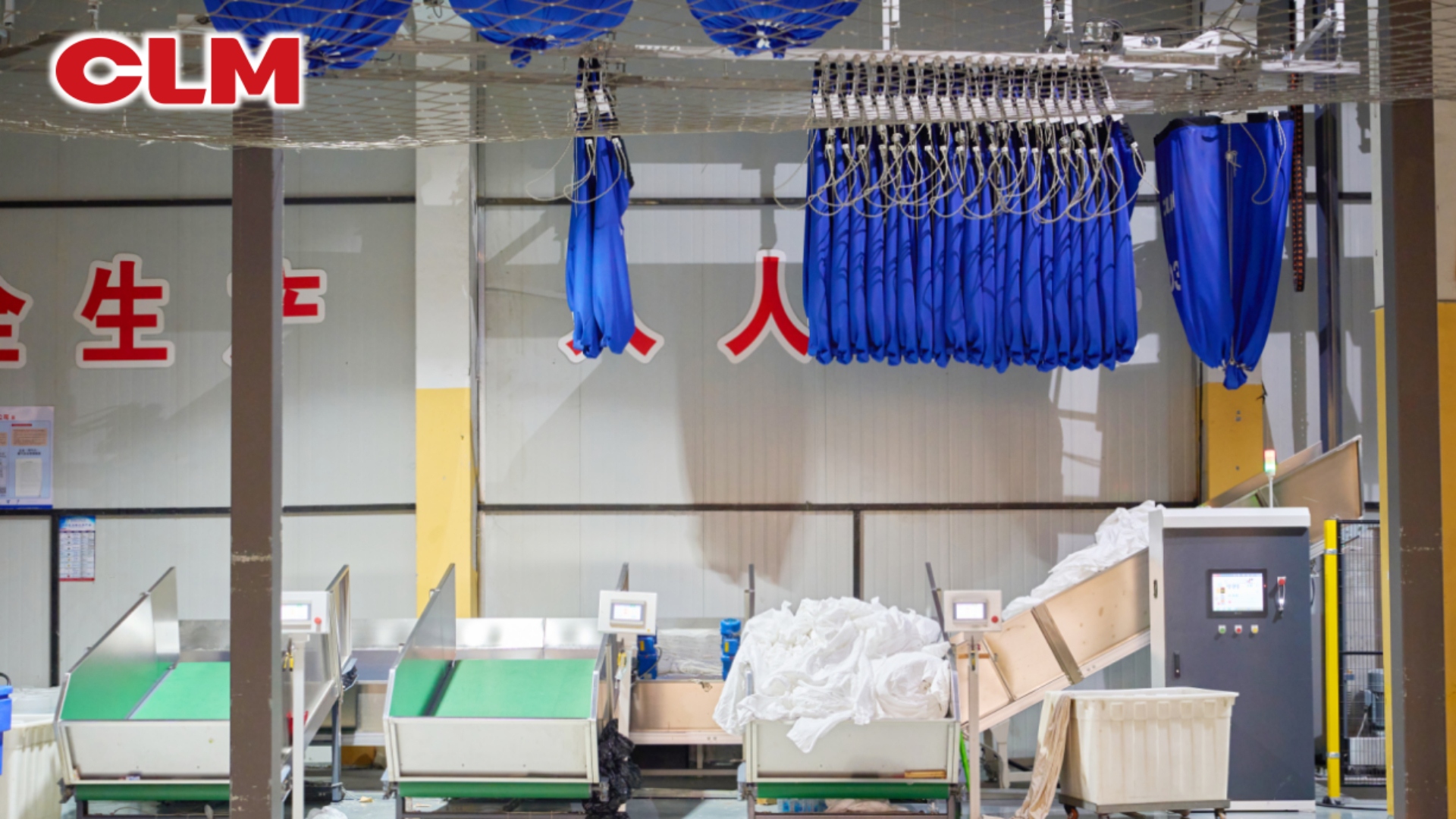
The hanging bag system, conveying line, AGV, loading conveyor, and other auxiliary equipment can achieve no linen on the ground.
- Intelligent control system
Machines with different functions from different brands work together to accept uniform dispatch.
- Data management and analysis system
It can collect the data of production, energy saving, and quality data to optimize the production, achieve preventive maintenance, and conduct consumption checks.
Post time: Feb-04-2026