
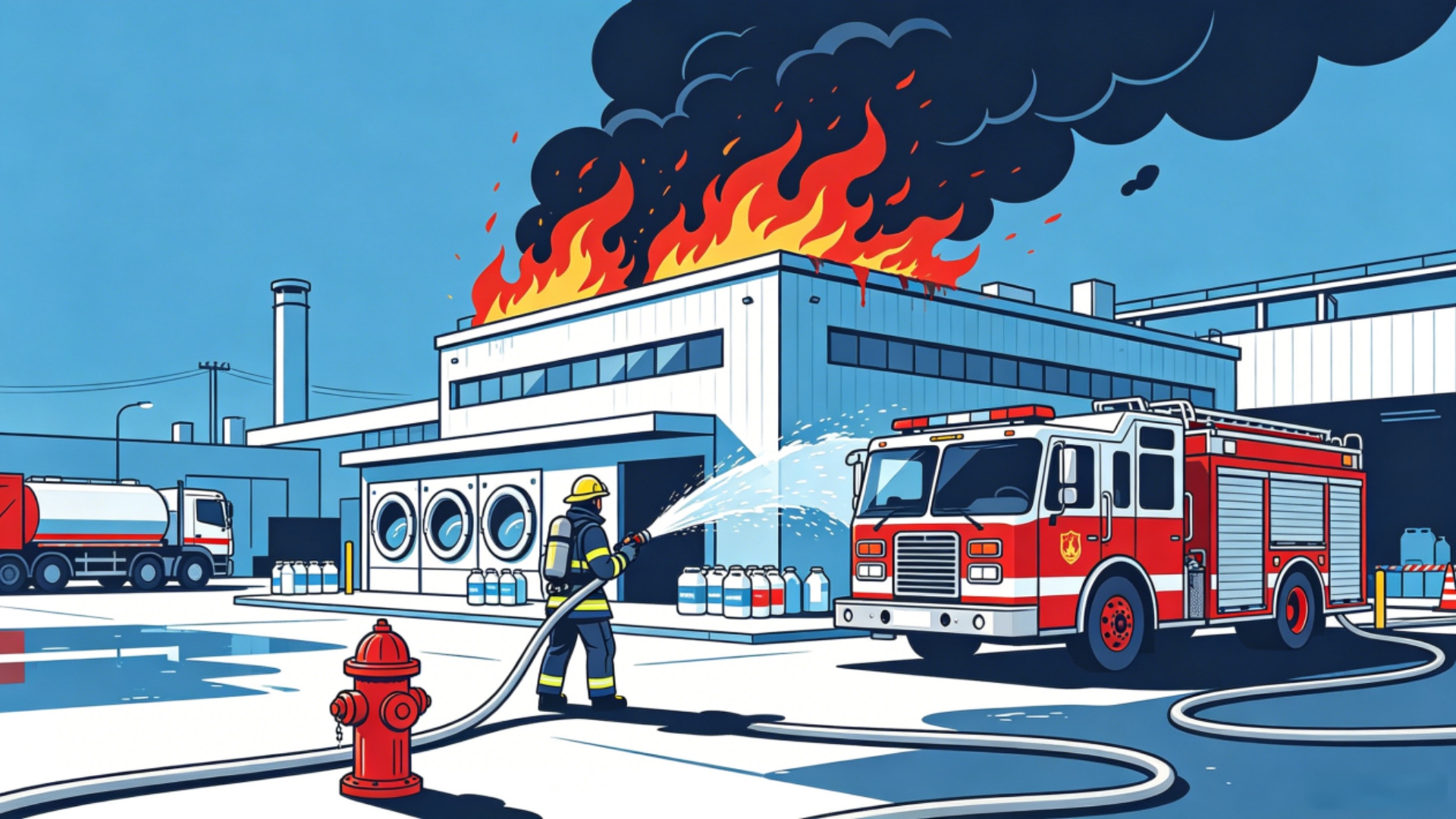
In industrial laundry plants, three core conditions for fire are caused by the production characteristics. Regular operations and materials may trigger a fire. This is also the root cause of frequent fire incidents in the industry. For any laundry plant, fire prevention is not a passive measure but a systematic strategy for factory construction, equipment selection, and daily operation.
As a professional smart laundry system integrator, Kingstar believes that it is essential to know the nature of fire risks. Preventing risks at the source is the foundation of plant safety and stable operation.
Three Major Fire Risks
● Flammable and combustible materials
Different types of textiles exist everywhere in laundry plants. They are extremely flammable materials, whether uniforms waiting to be washed, hotel linens, healthcare textiles, or clean linens. In workshops, a lot of oil stains, dust, and heavy soils adhere to recycled uniforms and industrial linens. These oil residues significantly increase the inflammability, whether in soiled linen areas, laundry workshops, or clean linen areas. They may become fuel for a fire.
● Oxidizing residue
In laundry plants, laundry chemicals (such as bleaching and oxidizing agents) are often used for industrial, hotel, and healthcare textiles. Improper wash programs and excessive chemical dosage may leave oxidizing substances in textile fibers. This easily triggers spontaneous combustion.
Besides, natural fiber textiles like cotton and linen are prone to self-heating oxidation. If the surface temperature of textiles reaches about 95℃, the self-oxidation reaction will start and continue to release heat. Heat accumulates constantly and accelerates oxidation, forming a vicious cycle. Finally, self-ignition occurs without external open flames. This accident accounts for a large proportion of laundry plant fires without any warning. So it is difficult to detect in time.
● Open flame & high-temperature risks
Heat sources in laundry plants are extremely diverse, such as industrial dryers, ironers, and other heat-generating equipment. Sometimes, fire originating inside equipment directly triggers incidents. Besides, freshly dried or ironed linens may be stacked for storage without heat dissipation and cooling. Heat continues to accumulate inside linen piles. In a short time, the temperature rises rapidly to trigger spontaneous combustion. This detail is often ignored by many small- and medium-sized laundry plants.
During the high-temperature period of summer, linen turnover boxes and textiles waiting to be washed are stored outdoors. After long-time exposure to sunlight, the temperature rises quickly to reach the ignition point, triggering fire incidents. This often occurs in hot and humid regions of southern areas.
Systematic Prevention Strategies
● Electrical system
Laundry plants are major electricity consumers. Fire incidents are mainly caused by electrical wiring, aging equipment, and electrical faults. Laundry operators should focus on the following measures. For example, licensed electricians must fully inspect equipment before the first use as well as after restart following modification and repair. In daily operations, plants should regularly conduct electrical inspections and maintenance. At the same time, keep the complete inspection records.
Kingstar solutions:
In the design stage, Kingstar fully considers the electrical safety of equipment. All electrical systems use high-quality flame-retardant cables and electrical components with a standard IP rating. Key components are also equipped with overheat and short-circuit protection devices. This reduces the risk of electrical fires at the source.
● Equipment selection
Many fire incidents are caused by the design flaws of the equipment itself. For example, lint accumulation inside dryers catches fire due to high temperatures. Overheated ironer bearings ignite the surrounding textiles. The first step to fire prevention is to choose equipment with a fire protection design.
Kingstar solutions:
Take the Kingstar direct-fired pass-through dryer as an example. It is equipped with three electronic temperature sensors and one thermal expansion temperature sensor. Its system automatically regulates burner output using PID control. This precisely controls the entire drying temperature. Overheating in any location, such as the air inlet, air outlet, or combustion chamber, causes the system to automatically shut down the burner and start the sprinkler system.
● Fire protection equipment & daily cleaning
All laundry plants should give priority to installing automatic sprinkler systems. Those without automatic fire protection systems, they should install fire detection systems and fire barriers in time. They should also provide enough fire extinguishers and hydrants. At the same time, they can appoint full-time fire safety officers and carry out fire drills regularly.
Daily cleaning cannot be ignored. Lint and dust in laundry plants are flammable materials. They easily accumulate on ceilings, equipment surfaces, pipeline gaps, and ground corners. Once exposed to open flames or high temperatures, they ignite instantly. So laundry operators should make routine cleaning rules. For example, regularly remove lint from equipment and pipelines. Promptly remove the dust from the ground by vacuum cleaning.
Kingstar solutions:
During the overall design and planning stage, Kingstar integrates fire access routes, locations for fire-fighting equipment, and preinstalled piping for automatic fire-extinguishing systems into solutions. At the same time, the equipment structure fully considers the easy-to-clean design. This reduces lint accumulation areas and daily maintenance difficulties.
● Personnel & access control
In laundry plants, there are external contractors like equipment maintenance, cleaning, and material transportation coming and going. Uncontrolled personnel access also leads to fire risks. Recently, many fire incidents have been caused by the improper operation of external personnel. For example, they misuse open flame tools like an angle grinder to repair. This accidentally ignites the surrounding textiles.
Kingstar solutions:
Laundry plants should strictly implement access control. External personnel and contractors should register for records. Make a fire safety briefing before work begins, such as prohibiting unauthorized hot work and operations. Hot work in laundry plants must be approved in advance. Operators should take protective measures. A designated supervisor should be arranged for on-site supervision.
Q&A
Q1: What fire protection designs does Kingstar equipment use?
A1: Kingstar uses multiple safety protections, such as automatic overheating protection and temperature sensors for industrial dryers, a heat-resistant sealing design for ironers to prevent lubrication leakage, high-quality flame-retardant components and overload protection devices for all electrical systems.
Q2: How can a running laundry plant conduct fire safety upgrades?
A2: Kingstar provides fire safety assessments as well as phased upgrade solutions. This includes electrical system inspection, equipment fire protection upgrades, fire protection facility improvements, and cleaning process optimization. Besides, simple measures like lint removal, flame-retardant pipeline replacement, and temperature monitoring installation can reduce fire risks.
Q3: Can Kingstar offer fire safety design services for a new plant?
A3: Yes. Kingstar is a provider of integrated smart laundry plant planning and design. Initially, it integrates fire safety into solutions, including fire access routes, fire compartment design, locations for fire-fighting equipment, and preinstalled piping for automatic fire-extinguishing systems. So a new plant can meet the highest safety standards from the first day.
Post time: Jul-30-2026