
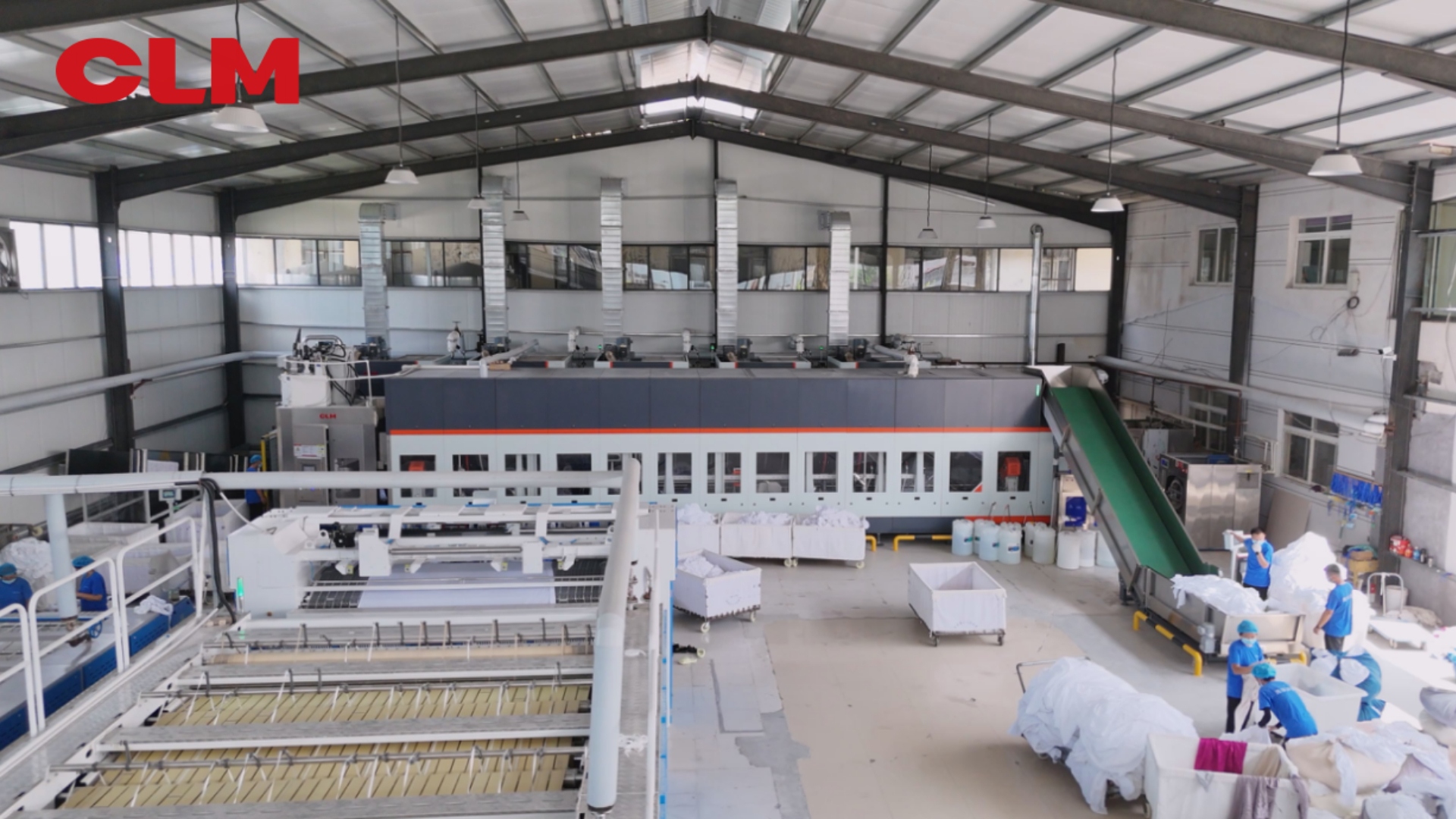
After the Clean Show in Orlando, USA, the senior leaders of the CLM Group visited some laundry palnts with a high degree of automation in the United States and found that some functions and performances of the equipment were not as good as those in China. However, in terms of overall planning and design, their laundry plants far exceeded those in China. There were no people walking around in the entire workshop. There were no linen carts being pushed back and forth either. Everyone was doing their own things at their fixed posts, looking so orderly and well-organized.
The Chinese laundry industry has been calling for the creation of “digital and intelligent laundry plants”. Taking the highly automated laundry plants in the United States as a reference, if we travel all over China, we can responsibly say that currently, there is not even a single laundry factory with a relatively high degree of automation in China. After sorting it out, we think the development path of Chinese laundry plants should be: the single-machine era → the era of automated equipment → the 1.0 era of intelligent laundry plants (the era of more automated laundry plants) → the 2.0 era of intelligent laundry plants → the 3.0 era of intelligent laundry plants.
Development Path of Chinese laundry plants and the Characteristics of Each Stage
● Era 1
The real development of China’s laundry plants began around 2008. Before that, most of these facilities relied on horizontal washers, centrifugal dehydrators, and basic roller ironers (manual feeding at the front end and manual folding at the back). It wasn’t until the price of 100kg washers dropped sharply that countless laundry plants upgraded to this equipment and started using folding machines. We call this phase the “Standalone Machine Era”.
● Era 2
Around 2012, tunnel washers and high-speed ironing lines were developed in China, and some laundry plants began to use these pieces of equipment. After nearly 13 years of development, more and more laundry plants are now using tunnel washers, high-speed ironing lines, and some simple conveying equipment. This period is what we call the “era of automated equipment”.
● Era 3
After 2025, we can clearly feel more and more operators of laundry plants in China want to open their second laundry plants or want to replace their old equipment with new generations of equipment. They said they want digital and intelligent laundry plants. Actually, they want to build a laundry factory with a higher degree of automation, which can also be understood as the 1.0 era of smart laundry plants. We believe that the era in China has arrived.
● Tunnel washers, ironing lines, and hanging storage bag systems are necessary for laundry plants with a higher degree of automation (the 1.0 era of intelligent laundry plants). Besides these devices, we also need to configure more conveyor lines and some supporting logistics auxiliary equipment to achieve logistics automation and process continuity. The application of efficient bag-lifting systems, conveyor lines, and other logistics systems can be used to replace the back-and-forth turnover of manual trolleys.
From the sorting, washing, and drying of linen at the front end to the ironing, folding, and packaging at the back end, all processes are seamlessly connected through means such as the intelligent hanging bag system in the air, the picking system, and the intelligent conveying system on the ground, forming a continuous assembly line. This ensures that all linen in the factory does not touch the ground or fall to the ground. All personnel can work at designated points and positions.
There is no bustling scene of people walking around and linen carts being pushed back and forth in the workshop. The core purpose is to improve the logistics turnover of the entire laundry factory, refine the laundry process, reduce unnecessary positions and personnel, improve efficiency, and lower costs.
● Era 4 and 5
The 2.0 and 3.0 eras of intelligent laundry plants involve integrating laundry equipment with Internet of Things (IoT) technology with the ERP management software of the laundry factory, and then continuously optimizing the entire operation process through software systems and artificial intelligence technology. That is to gradually achieve unmanned operation in workshops. To what extent is it unmanned? A laundry factory with a daily processing capacity of 30 to 50 tons only requires 2 to 3 managers in its workshop. Its core objective is to reduce costs, increase efficiency, improve quality, and achieve transparency.
Q&A
● Q: After visiting the American laundry plants, what are the main differences between Chinese and American laundry plants?
A: According to observations, the main gap does not lie in the performance of individual devices, but in the overall planning and design. In the highly automated laundry plants, everyone is working at a fixed position, and the entire process is well-organized.
● Q: According to the analysis, what stages has the development of Chinese laundry plants gone through? And where exactly is the Chinese laundry industry on this evolutionary path right now?
A: There are 5 stages.
At present, the Chinese laundry industry is at the threshold of moving from the “era of automated equipment” to the “era of smart Laundry Factory 1.0”. Since 2025, the demand for upgrading or building new laundries in China has been unprecedentedly strong, with the goal of creating “digital and intelligent laundries”. This essentially marks the arrival of the era of “more automated laundry plants” in China.
● Q: What are the differences between the future “intelligent Laundry Factory 2.0/3.0 era” and the current 1.0 era? What is the ultimate goal?
A: It is the upgrade from “hardware connection and automation” to “data integration and intelligence”.
1. Implementation method: Integrate the laundry equipment with Internet of Things (IoT) technology with the ERP management software of the washing factory, and continuously improve the entire operation process by using the software system and AI technology.
2. Final shape: gradually realize an unmanned “assignment” workshop. A clear criterion is that for a laundry plant with a daily processing capacity of 30 to 50 tons, only 2 to 3 managers are needed to operate its workshop.
3. Four core targets: achieve the ultimate goals of cost reduction, efficiency improvement, quality enhancement, and process transparency.
Post time: Feb-05-2026