
In the laundry industry, front-line production jobs are competing for young workers in many industries (food delivery, courier services, and livestream selling). Traditional practices (posting job ads and waiting for resumes) are becoming increasingly useless. In September 2026, a senior consultant in the US laundry industry, Richard Engler, wrote an article in the American Laundry News. He systematically analyzed the causes and possible solutions to this problem.
Why Traditional Recruitment is Becoming Harder
Over the past ten years, the laundry industry has relied on its recruitment methods, such as posting job ads on websites, joining job fairs, and using employee referrals. This approach was effective ten years ago because young people had fewer employment options. They were attracted by stable pay and benefits from plants.
However, the situation has completely changed.
● Gig economy: the biggest factor
Food delivery, ride-hailing services, and courier delivery provide young workers with immediate earnings. They can get paid as they work. By comparison, laundry plants pay salaries once a month. This is less attractive to young workers who require immediate earnings.
● Retail and logistics: divert the workforce
The barriers to entry for warehouse sorting, supermarket shelf-stocking, and express delivery are similar to those of laundry plants. But they offer a cleaner working environment and have greater social recognition. Some young people prefer to move boxes rather than entering laundry plants.
● Age structure: the underlying problem
The traditional workforce in the laundry industry is aging. In the US, the average age of industrial laundry workers is now over 45. Young generations (especially Gen Z, born between 1997 and 2012) show less interest in factory jobs than previous generations.
Engler wrote that the challenge is twofold: find them, and provide them with the things that matter to them. The problem is not that the young don’t want to work. But there are differences between what they want and what factories can offer.
Five Things that Young Workers Care About
Engler pointed out that young workers view employment very differently, compared with previous workers. Laundry workers need to understand and respond to their five apparent priorities.
● Financial speed
The gig economy features getting paid as workers finish the work. On Earned Wage Access (EWA) platforms like DailyPay or EarnIn, workers can gain a portion of their wages immediately after completing a shift. Also, transparent starting rates and clear overtime rules significantly improve applicant volume and employee retention.
● Flexible shift scheduling
The traditional three-shift system may conflict with young workers’ education, caretaking duties, and commuting needs. Micro-shifts, such as four to six hours, are suitable for students and part-time workers. A workweek of four 10-hour days provides a three-day weekend.
● Predictable work schedules
Post a fixed work schedule at least two weeks in advance. This allows employees to plan for childcare, commuting, and other needs. This seems to be simple, but it is an important detail overlooked by many laundry plants.
● Mobile onboarding
Desktop application systems may be inconvenient for the young. Optimize the system for a mobile-friendly application that supports 3-minute completion via text message or QR code submission. The time from application to conditional offer should be kept under 48 hours. Delays will cause candidates to accept positions that are offered sooner.
● Clear career pathways
Young workers are not interested in jobs that they consider dead ends. Showing career pathways from day one demonstrates long-term value. Cross-training can enhance workers’ marketable skills and provide the factory with more flexible staffing options.
In addition, Engler gives three actions that can be started today. First, audit the hiring process. Test the application system using a mobile phone. Remove unnecessary resume requirements and complex procedures for entry-level positions. Second, build three community partnerships. Connect to local vocational schools, community organizations, and non-profit organizations. This helps build a long-term talent pipeline, rather than starting to look when staff shortages arise. Third, modernize shift and pay practices. Try out flexible scheduling, develop on-demand pay options, and offer transparent pay rates. The three actions require little upfront investment. However, they may bring significant returns.
Impacts of Changed Workforce Structure
From the perspective of operations, the hiring department is not the only one affected.
The candidate pool in front-line positions continues to shrink. The average age of the workforce rises continuously. Factories have less room for workforce planning. Rising hiring costs are measurable. But there are other hidden costs worth attention. If processes heavily rely on manual workers, this can turn manageable fluctuations into operational risks that must be solved. Factories that have a limited number of talent sources may be less able to adapt to market changes.
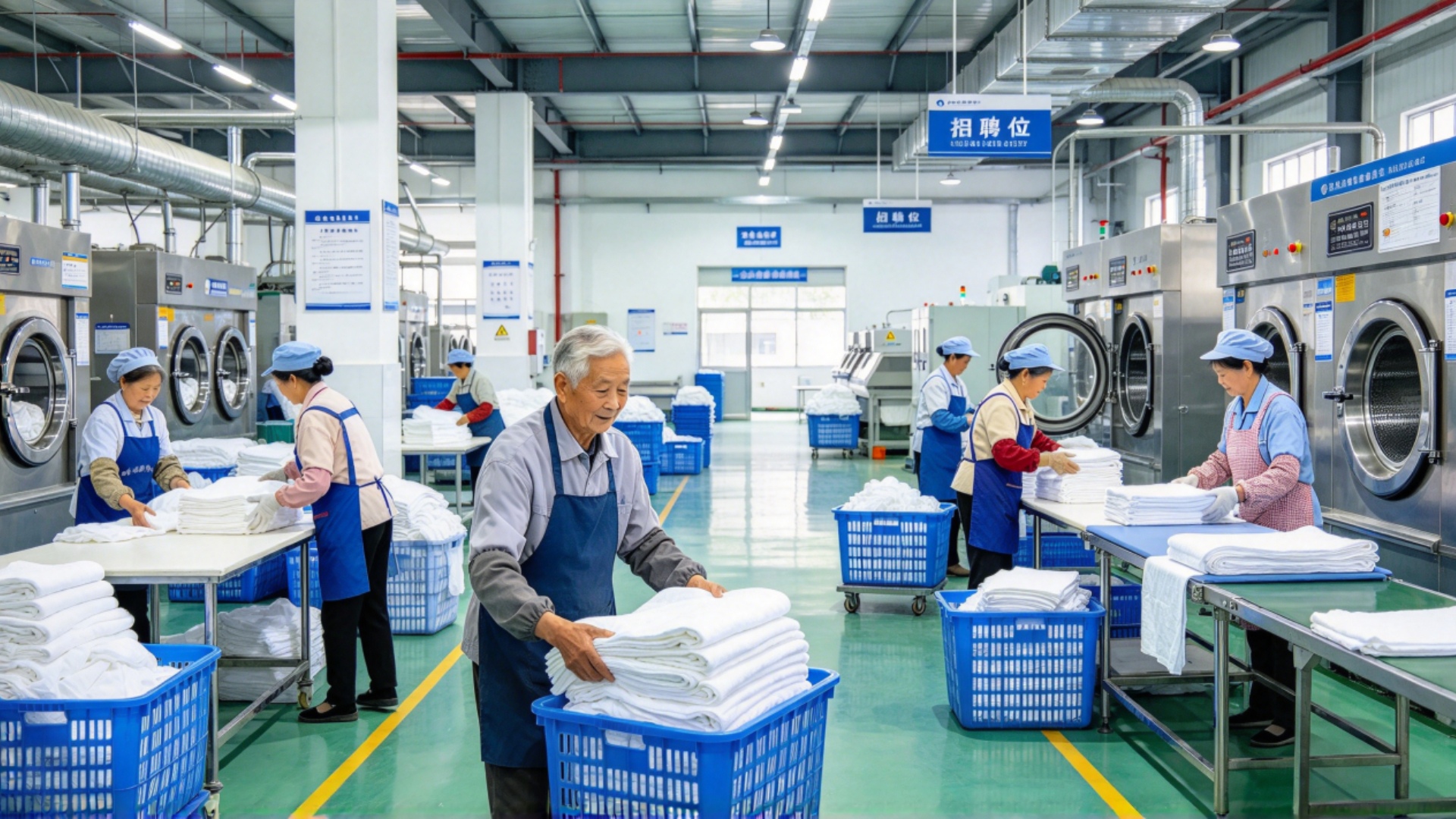
This also reflects a less noticeable shift in recent years. More and more laundry plants are moving away from hiring more workers and focusing on reducing labor needs and improving efficiency. They tend to choose smart laundry equipment. This helps them take over repetitive tasks in labor-intensive stages (linen sorting, spreading, ironing, folding, garment finishing, and linen transfer). Thus, work schedules, production capacity, and work-in-process status become easier to monitor.
Take Kingstar as an example. It develops tunnel washer systems, spreading feeders, ironers, folders, garment finishing lines, and laundry plant logistics systems. They are designed for this integrated production line. The front end handles linen sorting and spreading. The middle stage achieves ironing and folding. The back end connects linen flow across different stages via a logistics system. This production line cannot replace hiring. But it can reduce the factory’s reliance on fixed workforce size. Production scheduling becomes more flexible.
It should be noted that the payback period of equipment investment varies in factories. It is affected by local energy costs, linen mix, capacity utilization rate, and other factors. By comparison, improvements in recruitment (optimizing work schedules, ensuring transparent pay rates, and simplifying onboarding processes) require less investment and deliver results rapidly. The two approaches are not mutually exclusive.
Conclusion
The laundry industry is facing a pressure test of workforce structure. However, opportunities are also involved in these challenges. Laundry plants that change the ways of hiring and employee retention first are more likely to gain a competitive advantage in the future. If factories are still using the methods from ten years ago to hire employees, recruiting employees will become more difficult. Laundry operators who are willing to step outside their comfort zones may find a talent pool that has been long overlooked.
Q&A
Q1: What are the root causes of recruitment challenges in the laundry industry?
A1:
● Gig economy
Jobs that offer immediate earnings are more attractive.
● Competition from the retail and logistics industry
● Aging workforce structure
The average age has exceeded 45.
Traditional recruitment is gradually becoming useless.
Q2: What should laundry plants do first if they have to do one thing?
A2: Audit their hiring processes. Use a mobile phone to complete an application. Calculate how long it will take from application to conditional offer. Unnecessary hiring requirements, desktop-side limitations, and slow response are less costly and can be easily addressed.
Q3: What is the relationship between recruitment improvement and production line automation and equipment upgrade?
A3: They address two aspects of one problem. Recruitment improvement can increase the available workforce. An integrated equipment line and logistics system reduces the number of required workers for each unit of output. They also reduce the reliance on experienced workers. For factories that face long-term labor shortages, this combined solution is more effective than a single method.
Post time: Nov-18-2026