
In the laundry processing workflow, soiled linen sorting is at the beginning of the line. It is also a labor-intensive stage, which is difficult to standardize. Piles of linen have different types and sizes and may contain foreign objects. Manual handling is physically demanding and relies heavily on individual experience. Recently, Kingstar released a soiled linen sorting system. It combines AI image recognition with an automated control system. This replaces manual visual judgment with a continuous automated process — recognition, picking, and traceability. This provides a mechanized solution for labor-intensive stages of laundry processing.
Why Soiled Linen Sorting Is Difficult
● Incoming linen
Soiled linen enters the production line in piles. It may be stacked or entangled. If piles of linen are directly processed by a robotic arm, this increases the risk of missed or inaccurate picking. It is also hard to maintain the production rhythm. The front end must separate piles of linen into individual pieces. This helps improve the robotic picking success rate.
● Recognition standards
Linen differs greatly in types, colors, sizes, and soiled levels. Manual sorting relies on experience. Sorting criteria can easily vary between different shifts and staff. Sorting mistakes can affect the back-end processing. If foreign objects enter the laundry equipment, linen may be damaged. Improper sorting can increase the risk of cross-contamination between clean and soiled linen.
● Data management
In the long term, it is difficult to record linen origin, destination, and the number of wash cycles. Production management and cost accounting lack usable raw data. As the first stage before linen enters the laundry process, sorting is an entry point for data collection.
Kingstar’s Automated Linen Sorting Solution
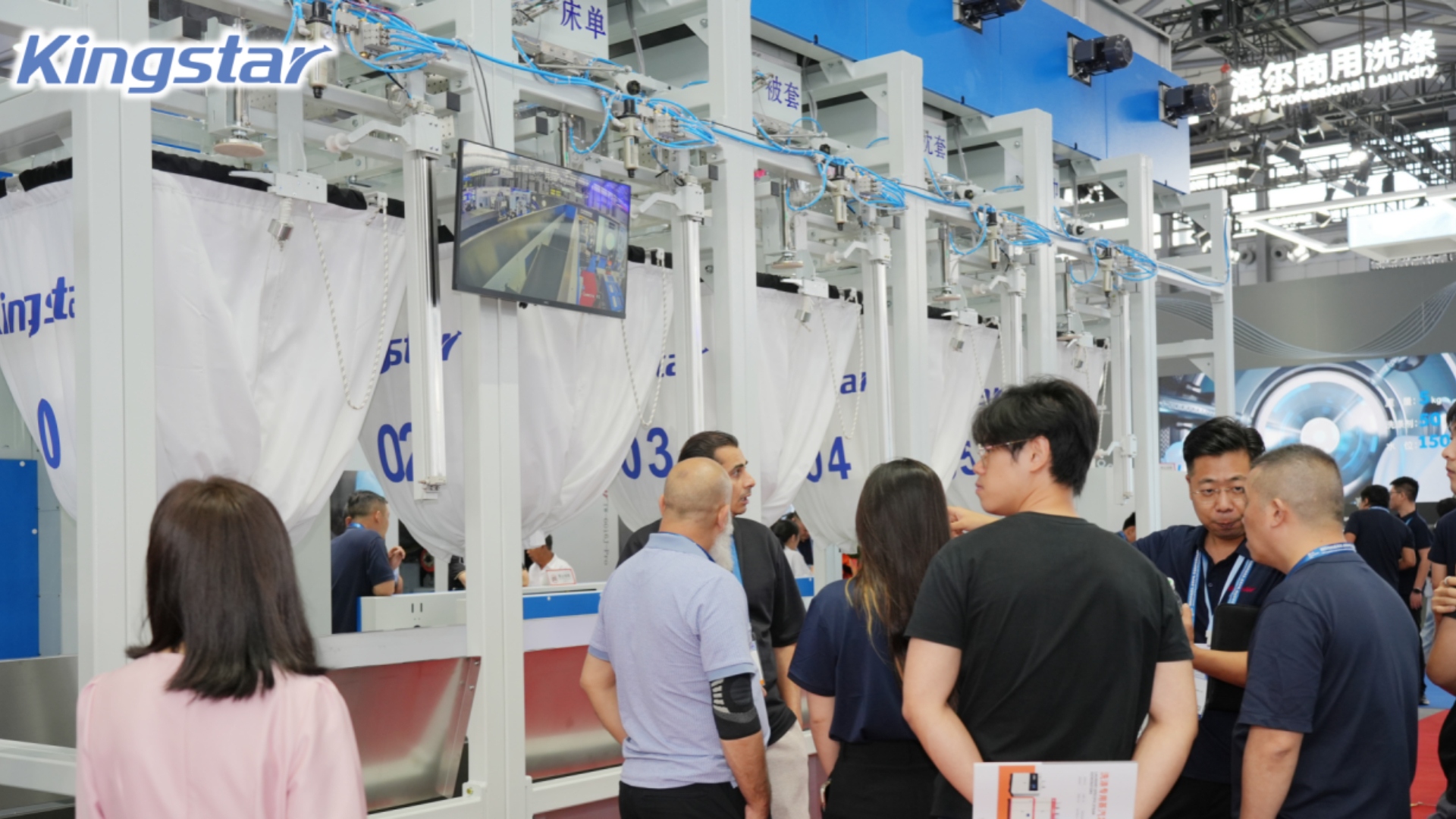
Kingstar’s soiled linen sorting system integrates multiple technologies. Among them, AI control is a critical part.
● AI recognition and picking
The system uses image recognition to build a large-scale model database. It precisely identifies linen types, colors, sizes, and soiled levels via AI learning. This provides a basis for follow-up picking and sorting. To match the recognition results, the system is equipped with a new parallel robot arm. This significantly saves picking response time and improves overall processing efficiency. A newly designed gripper integrates motors, solenoid valves, and sensors. It can quickly pick different types of linen. This helps handle different types of incoming linen.
● Front-end conveying and linen separation
The system uses an efficient conveyor system (a material discharge mechanism, multi-item leveling device, and differential-speed separation conveyor). Piles of linen are separated into individual pieces. This improves the robotic picking success rate. In addition, it is easy to connect to different groups of conveyors. On-site disassembly and assembly are convenient. This ensures stability and continuity during conveying. The conveyor is driven by geared motors and variable frequency drive (VFD) control. It has the capabilities of overload protection and automatic fault diagnosis. Besides, pneumatic cylinders and drive units are equipped with photoelectric sensors and position detection. This achieves smooth and reliable operation.
● Foreign object removal and linen identification
The system precisely removes linen containing foreign objects via X-ray scanning. This reduces linen damage or contamination in the subsequent processes. Meanwhile, it uses RFID technology to build a linen information management system. Linen movement can be tracked and recorded in real time (linen origin, destination, conveying time, colors, and number of wash cycles). This provides support for production management and strategy through data analysis.
● Downstream sorting and weighing
The back-end sorting conveyor uses geared motors and a drive system. Linen can be quickly sorted and sent to the designated overhead bags, cage trolleys, or conveyor lines. Each sorting lane is equipped with a buffer hopper with a weighing system. Linen weight and information for each bag type can be recorded in real time. This provides data support for laundry processes.
● Modular control and smart monitoring
Combined with an automated control system based on PLC and the Industrial Internet, the sorting system achieves centralized control and coordinated operation among all units. Operators set parameters and monitor processes via touchscreens. The entire sorting workflow is divided into multiple stages. They can be laid out flexibly on site. In addition, the system uses fault diagnosis and alarm functions. Equipment operating status is monitored in real time, including motor current, motor voltage, conveyor belt wear, and pneumatic cylinder operations. When abnormal conditions are detected, the system issues an alarm promptly and displays fault data. Thus, workers can take appropriate action. This reduces equipment downtime and maintenance costs.
How the System Benefits Laundry Plants
● Changes in front-end positions
Soiled linen sorting requires significant physical effort. Workers are more likely to come into contact with foreign objects. But the system enables recognition, picking, and sorting. Workers need to monitor and handle abnormal situations. Thus, staff requirements should be evaluated based on production capacity and shift schedules.
● From experience-based judgment to AI recognition
AI learning makes linen sorting consistent. Recognition results are recorded as data. Linen sorting remains reliable, less affected by staff changes. This change is critical for plants that require high linen sorting accuracy.
● Linen data management
RFID records work together with overhead bag weighing systems. This establishes a traceable record system for linen origin, destination, number of wash cycles, and weight. The number of wash cycles can be used for linen service life management. Overhead bag weight provides raw data for weight-based billing and production capacity analysis.
● Integrate with the entire production line
The soiled linen sorting system is located at the front end of the production line. Its output is a flow of sorted linen and usable process data. Across the entire production line, the Kingstar tunnel washer system, spreading feeder, ironer, folder, garment finishing line, and smart logistics system are also designed to reduce manual intervention and ensure continuous workflow. The sorting system is the starting point for linen recognition and data collection before linen enters the laundry process.
Conclusion
The soiled linen sorting system goes beyond replacing manual handling with automated operations. More importantly, it completes two tasks at the front end of the process simultaneously. First, piles of linen can be identified by AI. Second, linen can be tracked and recorded via RFID and weighing systems. The output from the sorting stage shifts from material flow to material and data flow. Production management in a laundry plant provides a data foundation for downstream processes.
Q&A
Q1: What issues does the system solve?
A1: Front-end soiled linen sorting. The system replaces manual handling through automated conveying and separation, AI recognition, and robotic picking. Piles of linen are sorted and sent into the designated overhead bags, cage trolleys, or conveyor lines. This can reduce physical effort. Also, sorting consistency is improved.
Q2: What is the role of AI in the system?
A2: The system can build a large-scale model database with image recognition. It precisely identifies linen information (types, colors, sizes, and soiled levels) via AI learning. This also provides a basis for picking and sorting.
Q3: Can the sorting system connect to an existing laundry production line?
A3: The equipment uses a modular system. Its entire workflow is divided into multiple stages, which can be laid out flexibly on site. It is easy to connect to different conveyor modules. On-site disassembly and assembly are also convenient.
Post time: Nov-20-2026