
During pillowcase finishing stages, laundry plants often face real challenges, such as heavy reliance on manual labor, inconsistent smoothness, and fluctuating production efficiency. Although pillowcases are small, during bulk processing, each step (loading, positioning, spreading, and feeding) directly affects the production capacity of ironing and folding. Recently, Kingstar launched an automatic pillowcase feeder for the bulk pillowcase finishing requirements of laundry plants. It provides a continuous solution, from automatic loading to smooth conveying.
Why Pillowcase Finishing Becomes a Bottleneck
During finishing processes, pillowcases are smaller than bed sheets and duvet covers. They also have more corners. Manual feeding easily causes corner bunching, wrinkles, and positional misalignment. Under traditional processing, operators need to spread, align, and feed the pillowcase into the ironing machine one by one. The labor intensity is high, and the feeding quality highly relies on operators’ skills.
In laundry plants, labor costs and order volume continue to increase. The efficiency and consistency of pillowcase handling are critical for finishing line upgrades. If the pillowcase processing capacity cannot keep up with the ironing and folding speeds, the entire finishing workflow can be bottlenecked. Therefore, Kingstar develops an automatic pillowcase feeder.
Kingstar Equipment Advantages
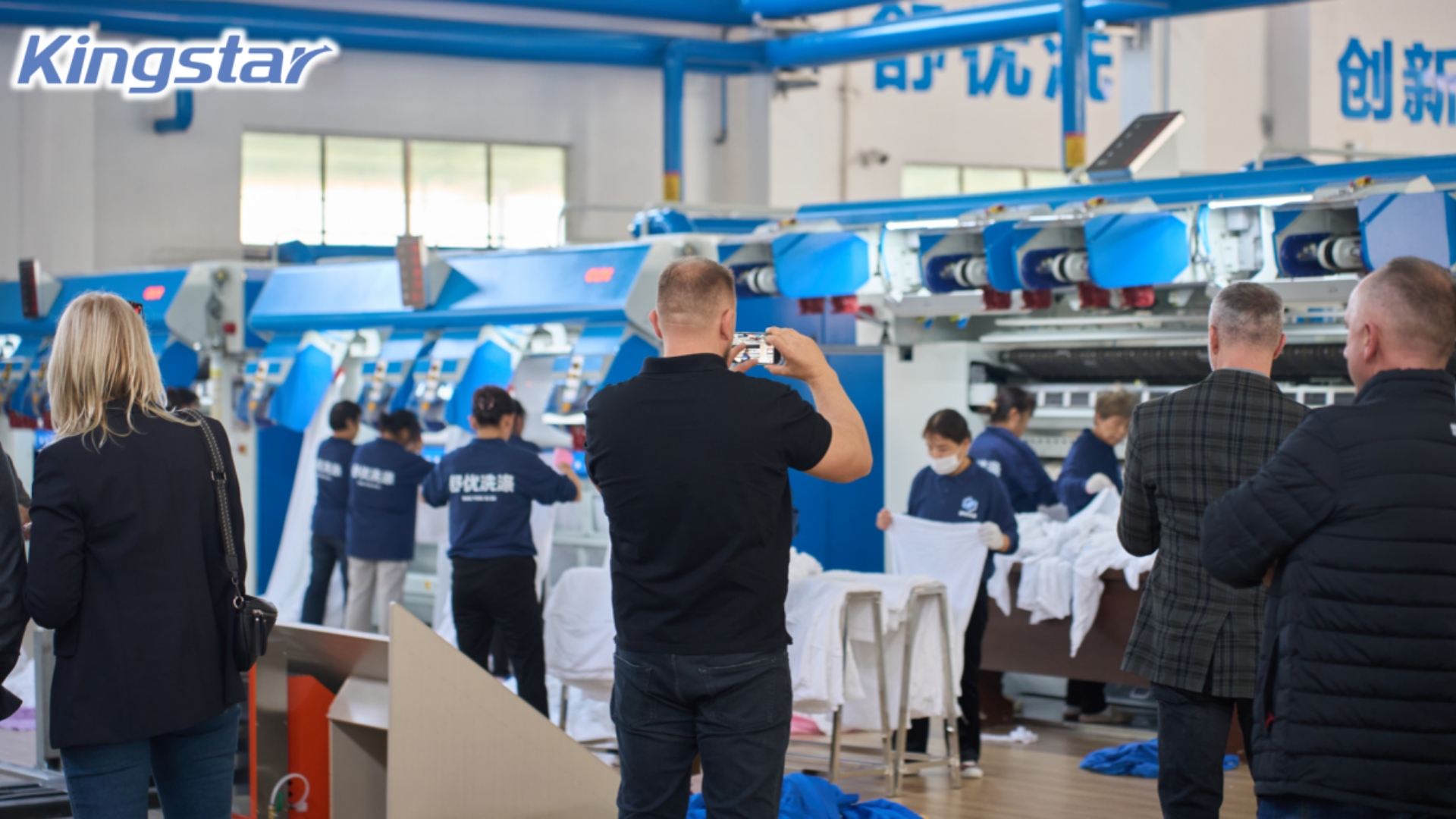
The Kingstar automatic pillowcase feeder is designed for hotels, hospitals, and industrial laundry plants. It meets their bulk pillowcase finishing requirements. It can load, position, spread, and convey the linen automatically and smoothly. Also, it can work together with ironers and multi-function pillowcase folders. This forms a continuous automated production line.
● Operations
The equipment uses an automatic feeding system. Operators only need to feed the two corners of the short side of the pillowcase into the spreading clamps. Robotic arms can automatically finish the following tasks. This design significantly reduces manual operations. The equipment feeds and smooths out pillowcases automatically. It can convey 20 pillowcases per minute. This meets the bulk pillowcase finishing requirements.
● Smoothness
The equipment has four optimization stages.
– Stage 1
A unique air duct structure works with feed rollers. They flap the drawn-in pillowcases and unfold bunched corners.
– Stage 2
The baffle narrows the outlet as pillowcases are pulled out of the air duct. Thus, pillowcases can enter the conveyor belt smoothly.
– Stage 3
The front brush smooths out the pillowcases. This can reduce wrinkles at the edges and corners.
– Stage 4
Before pillowcases enter the ironer, the rear brush smooths them out from the center outward. This can reduce overall wrinkles. Also, this ensures pillowcases are smooth when they enter the ironing machine.
● Specification
The space between the spreading clamps in each workstation can be adjusted. Its range is from 300 mm to 600 mm. This can apply to different pillowcase sizes. Control modes include program settings and manual adjustment. This meets different production conditions.
● Stability
The equipment is equipped with 9 variable frequency drives (VFDs). Each controls a set of motors. This ensures precise and stable operations. Also, this machine uses a high-precision servo control system. It can precisely control equipment running speed, working pace, and feeding positions. This ensures stable and efficient feeding processes. Also, this design improves production consistency.
● Maintenance
The equipment uses a modular design. It consists of six modules, including main frames, front brushes and flip-up inspection mechanism, fan and air duct components, pillowcase conveyor lines, end brushes, and automatic feed and flip-up inspection mechanism. Each module is independent. They can ensure daily maintenance, troubleshooting, and component replacement. This further improves the equipment’s long-term operational reliability.
Practical Significance
● Staffing structure
From the perspective of production lines, the automatic pillowcase feeder first changes the staffing structure. Originally, pillowcase feeding required continuous, repetitive manual operations. Now, it has been simplified to hanging the pillowcase on the spreading clamps by one person. This significantly reduces labor intensity. Workers can be redistributed to other processes that need manual assessment.
● Improved efficiency
The new machine can feed 20 pillowcases per minute. It matches the processing pace of mainstream ironing machines. Thus, this reduces pillowcase waiting and stacking before ironing. It can improve the consistency of the finishing production line.
● Consistent quality
Mechanical action ensures pillowcase feeding positions, spreading conditions, and smoothness. This reduces quality differences caused by operational fluctuations. Pillowcase conditions can be more stable and controlled before ironing.
From the perspective of industry trends, the automation of the finishing processes in laundry plants is expanding from large linen to small linen. The automatic pillowcase feeder does not reflect a single machine upgrade. It also shows laundry plants’ focus on the efficiency balance of the entire production line. They no longer focus on the speed of a single machine, but on the coordination and match between different processes.
Conclusion
The Kingstar automatic pillowcase feeder is centered on actual finishing processes. It provides a systematic solution for ensuring feeding methods, smoothness control, specification adaptability, stable operations, and convenient maintenance. For laundry plants that are optimizing their pillowcase processing, this machine can be used as an alternative for finishing line upgrades.
The automatic pillowcase feeder’s value lies in pace matching and staff efficiency during real operations. Today, in the laundry industry, hiring pressure and quality requirements are rising simultaneously. The automation of the finishing processes is becoming critical to improve overall production capacity for laundry plants. Based on the modular and precise control design, Kingstar provides a new solution for pillowcase processing. It is worth attention in real operations.
Q&A
Q1: What issues can the automatic pillowcase feeder address?
A1: It can load, position, spread, and convey pillowcases automatically and smoothly. It replaces manual feeding one by one. Also, it can coordinate with ironers and multi-function folders. They form a continuous, automated production line.
Q2: Is operating the machine difficult? What is its speed?
A2: Workers only need to feed the two corners of the short side of the pillowcase into the spreading clamps. Robotic arms can automatically finish the following tasks. The machine can convey 20 pillowcases per minute. It is suitable for bulk pillowcase post-processing.
Q3: Can the machine process different sizes of pillowcases?
A3: Yes. The space between the spreading clamps in each workstation can be adjusted. Its range is from 300 mm to 600 mm. Control modes include program settings and manual adjustment. This can meet different pillowcase sizes and production requirements.
Post time: Nov-12-2026