
The global laundry industry is quickly shifting to smart automation. A Kingstar garment finishing line has been successfully installed at a U.S. laundry plant. It has been running steadily for over one month. This automated production line with drying and folding processes helps reduce labor costs and improve operational efficiency. It provides another successful example of a smart upgrade in the overseas laundry market.
Growth Challenges
The U.S. laundry plant mainly undertakes the laundry business for chef and service uniforms and restaurant linens. With the development of the local catering service industry, the company’s workload continues to grow. Currently, it processes up to 5000 garments per day. Workers have to process at least 625 garments per hour. Facing the growing business demands, the plant often requires employees to work overtime. High labor costs become a bottleneck limiting business growth.
The laundry plant fully relied on manual labor before introducing the Kingstar garment finishing line. After washing, garments were loaded into industrial dryers by workers. Then, the dried garments were conveyed into the folding area and folded manually by another group of workers. Nearly ten workers were required to operate the two processes separately. This increased labor costs and turnaround times between processes, reducing overall efficiency. As business volume continued to rise, this traditional workflow was becoming difficult to meet production demands.
Production Upgrades
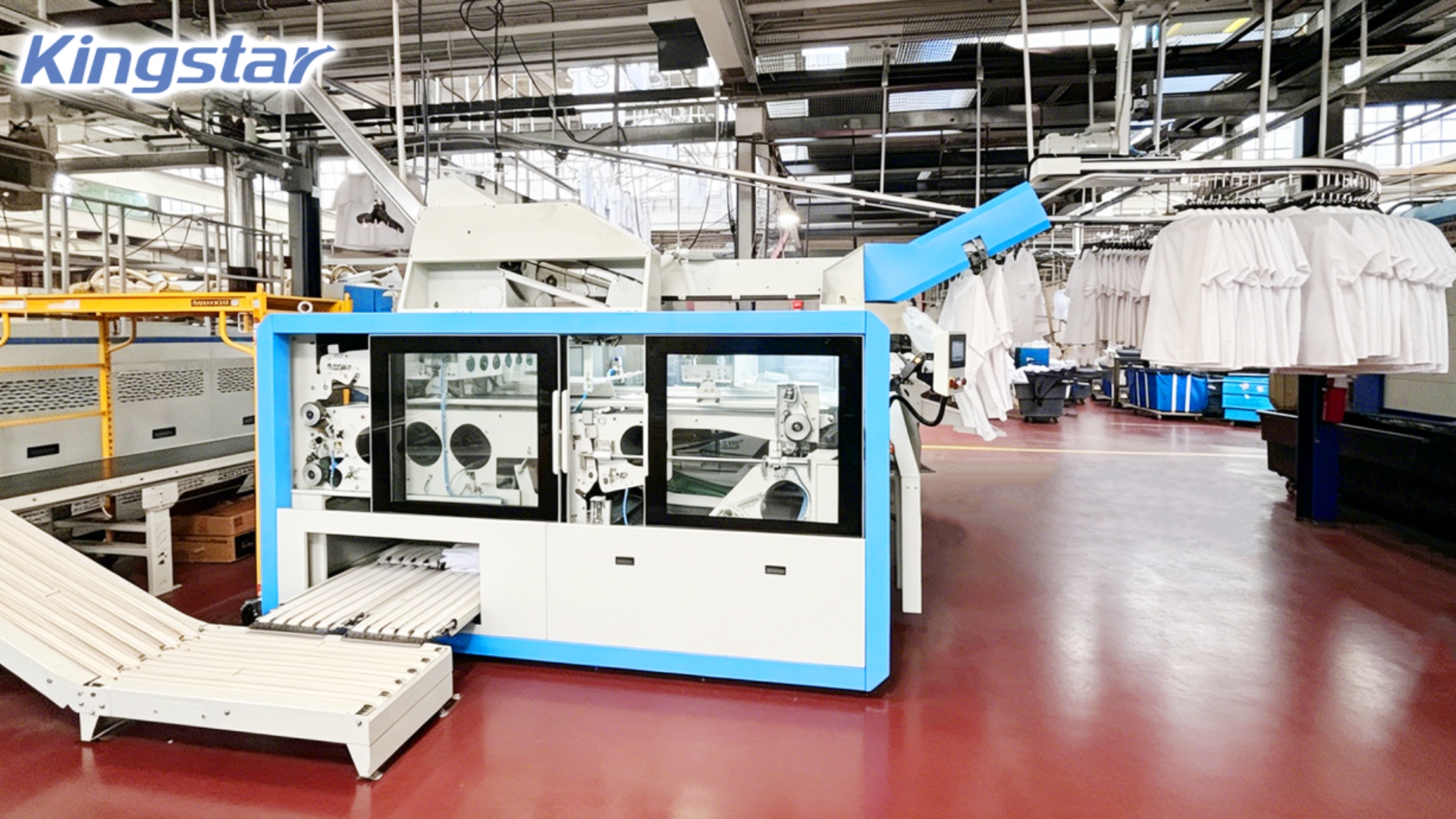
After the Kingstar garment finishing line was put into operation, the plant’s production model changed fundamentally. The drying and folding processes are integrated. Once washed, garments directly enter the processing line. Workers for drying and folding are not required anymore. They only need to hang garments on the specialized hangers. The equipment can automatically complete the entire process according to garment types.
At present, the garment finishing line only requires four workers to finish all the work. At the same time, efficient and stable operation allows workers to complete tasks within the set time even in fluctuating business conditions. Workers don’t need to work overtime. Their workload has been significantly reduced.
Professional Services
During the initial project stage, considering the business volume continuing to increase in the future, the customer clearly stated the needs of processing 800 garments per hour to reserve capacity for future expansion.
To meet customer demands, the engineering team in Chuandao conducted an on-site plant layout survey. They analyzed the garment types, specifications, and fabric features while deeply understanding the actual plant operations. Based on the detailed data, the team quickly customized a solution. From solution determination and equipment production to testing and shipment, the entire process took only six months. The efficient execution significantly shortens customers’ waiting time while ensuring the new production operates as soon as possible.
After the equipment was delivered to the customer’s plant, after-sales engineers arrived and immediately started installation, commissioning, and staff training. From hardware installation to operation guidance, the whole process ensured smooth operation, which reflects the professional service “ready for operation upon delivery” of Chuandao.
Equipment Advantages
The garment finishing line features a gas-heated system. The entire structure is a four-station, six-compartment drying tunnel, as well as a dual-stack garment folder. The customer’s plant has two floors. According to the actual space, Chuandao’s team designed a scientific and proper production line. Garments are loaded on the first floor and are delivered through the rail system to the second floor for drying. Then, they are conveyed to the first floor to automatically complete folding, stacking, and shipping. The coordinated operation of the upper and lower floors maximizes the space utilization.
Kingstar garment finishing line is equipped with a smart identification system at every feeding station. The system automatically matches garments with hangers by identifying RFID chip data inside garments. It is capable of identifying the information of different customers and garment types, as well as displaying the detailed information on the screens of feeding stations in real time.
The garment finishing line automatically adjusts the folding methods to achieve sorted stacking based on the garment types and preset programs. For garments without RFID chips, operators only need to manually select garment type via touchscreen. The equipment can complete all the following processes automatically. It is convenient to operate and flexibly applies to various demands.
Compared with manual operations, Kingstar garment finishing line manages drying programs more precisely, avoiding problems such as excessive or insufficient drying. The dried garments have better flatness before being folded precisely. Finally, the appearance and flatness of garments are significantly improved. This not only enhances the delivery quality of garments but also increases the customer’s market competitiveness.
Conclusion
With the outstanding operational performance, Kingstar garment finishing line has gained high recognition from overseas customers. The production line has been running smoothly for more than a month. All the indicators meet or even exceed expectations. The successful case shows that Kingstar smart solutions in the garment finishing area can create practical value for customers.
In the future, Chuandao will continue investing in technology development, upgrading product performance, and providing high-quality smart equipment for global customers in the laundry industry. Whether uniforms, linens, or other garment types, Kingstar will work on offering more efficient, intelligent, and reliable total solutions, helping laundry businesses worldwide reduce costs, improve efficiency, and promote upgrades.
Post time: Jun-04-2026