
Large-scale laundry plants and hotel laundry rooms process bulky linens every day. Premature linen damage and disposal have long been major challenges. This issue significantly increases linen replacement costs. Many practitioners blame the damage on fabric quality. In reality, 90% of fiber damage is caused by improper washing processes, chemical dosing, and improper equipment parameter control.
As a professional smart laundry system integrator, Kingstar has specialized in the R&D and manufacturing of tunnel washer systems, high-speed ironing lines, and overhead bag conveyor systems. It provides integrated planning services for global hotels and large-scale laundry plants. Based on thousands of laundry projects, Kingstar analyzes the root causes of linen damage. With its automatic laundry equipment and technological advantages, it develops standardized solutions. It is effective in reducing fabric damage and extending linen service life at the source.
Root Causes
● Loss of fiber strength
Cotton fiber strength continuously declines. The linen becomes more brittle after repeated washing. It can be torn by a slight force. This is a main cause of premature linen damage.
● Unbalanced chemical control
The concentration of chlorine and oxygen bleaching agents exceeds the normal level. During the bleaching stage, due to lower pH and higher temperatures, cellulose fibers are directly corroded. Because of the main wash high temperature and strong alkaline chemicals, fiber structures continue to be broken down. Excessive neutralizing acid agents weaken fabric strength.
● Improper equipment parameters
Due to manual operations, traditional single machines operate with lower water levels. This worsens the linen tumbling friction. The chemical concentration of localized areas is higher. Besides, there is no standardized control for the washing time. Long-term mechanical scrubbing continuously damages fibers.
● Metal ion catalytic oxidation
Trace metal ions in water, such as iron and copper, accelerate bleach decomposition. This indirectly corrodes the entire batch of linen fibers.
● Localized pinhole & spot damage
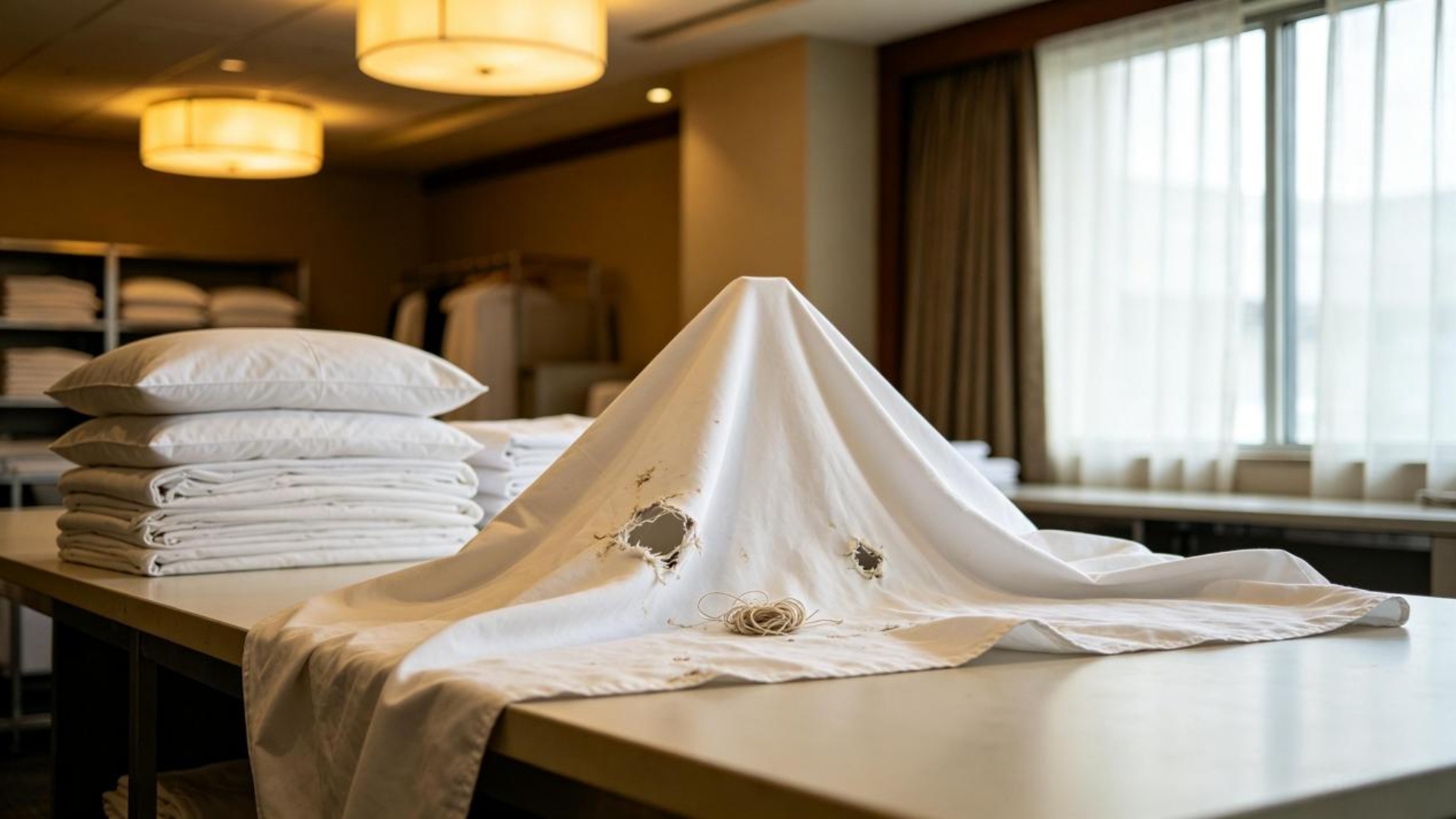
Localized embrittlement is mainly caused by manual operation errors. It is often easy to identify. If undiluted caustic soda or high-concentration bleach contacts the linen surface, localized chemical concentration may become higher. This corrodes fabrics and forms pinholes in a short time. If bleaching chemicals are incompletely dissolved, localized chemical accumulation may cause fiber embrittlement and damage.
● Sudden mass damage
Various substandard operations can result in mass linen disposal. For example, the linen is not pre-rinsed in time after contacting corrosive chemicals. Operators choose improper chemicals. Metallic impurities cause catalytic oxidation. Parameters (washing, extraction, and drying) are not properly controlled. This leads to mass linen tear and damage at once.
● Abnormal towel damage
Towel fibers become thinner while friction loss is more visible. The damage rate of towels is higher than that of bedding. Residual substances caused by strong alkaline chemicals, chlorine bleach, and neutralizing acid agents continue to corrode fabrics. Low water level may increase linen friction. High-speed extraction tears fibers. Higher drying heat and processing time cause fiber embrittlement. Rinsing cycles and water level are often insufficient. Long-term chemical residues are a hidden cause of repeated towel damage.
Traditional Washing Limitations
Traditional washing depends on manual control for chemical dosing, water temperature, and rinsing time. There are three uncontrollable drawbacks.
Manual dosing easily causes excessive bleaching agents and alkaline chemicals.
Tumbling space is limited inside the drum. The linen is under severe compression and friction.
Rinsing processes rely on worker experience. This cannot ensure water levels and rinsing cycles. Chemical residues often accumulate to damage fibers.
Kingstar Targeted Solutions
To address linen damage issues, Kingstar provides its tunnel washer system. Its end-to-end smart control modules can achieve gentle, low-damage washing.
● Precision chemical dosing system
Based on linen types and grease contamination levels, it automatically selects proper chemical dosage (bleaching agents, alkaline chemicals, and neutralizing acid agents). This protects fibers from being damaged by excessive chemicals. Automatic chemical dilution avoids localized high concentrations which could damage the linen.
● Gentle low-damage drum structure
Wider drums and improved lifters are used to increase linen tumbling space and reduce mechanical abrasion. A smooth transportation design at the bottom reduces linen stretching, snagging, and tearing.
● Section-based standardized washing process
Different sections (prewash, main wash, bleaching, neutralization, rinsing temperature, washing time, and water level) are monitored separately. Gentle washing programs can be used for towels and bedding. This can strictly control water temperature and pH values.
● Countercurrent rinsing
Multiple-stage rinsing can remove acid and alkaline residue inside the linen. Real-time water quality monitoring filters metal ions, which reduces catalytic damage risks.
● Integrated plant support solution
Linen can be sorted and transported by a smart overhead bag conveyor system. This reduces manual handling and pulling. Fabric embrittlement can be avoided through a high-speed ironing line with low-temperature drying.
Operation Suggestions
Choose washing programs based on different linen types. For cotton fabrics, strictly control washing temperatures and chlorine bleaching usage frequency.
Dilute all strong-corrosive chemicals in advance. Do not allow them to directly contact the linen.
Regularly check metal ions and water hardness. Use soft water pre-treatment.
Replace human-operated machines with automatic tunnel washers. This helps monitor the full-process operational parameters.
Conclusion
Linen damage is essentially caused by washing processes and uncontrolled chemical control. Traditional manual washing mode is difficult to stably monitor all parameters. Kingstar smart tunnel washer systems feature automatic, standardized, and gentle washing techniques. It reduces fiber damage through multiple methods, including chemical dosage, mechanical friction, chemical residue removal during rinsing, and water quality control. Kingstar also provides integrated laundry plant planning solutions. Therefore, hotels and laundry plants can reduce linen replacement spending and operating costs. They will achieve long-term, consistent, and high-quality washing.
Q&A
Q1: Why is linen easily torn after repeated washing?
A1:
Excessive bleaching and strong alkaline chemicals;
Incomplete rinsing causes chemical residues;
Higher water temperatures;
Metal ions in water cause catalytic fiber damage.
The long-term accumulation causes a continuous decline in fiber strength.
Q2: Towel damage rate is higher than that of bed sheets. How to address this issue?
A2:
Lower washing spin speed;
Shorten drying time;
Increase rinsing cycles;
Set specialized gentle programs for towels;
Precision chemical dosage control to reduce friction and chemical residues.
Q3: Why does single machine washing easily cause pinholes?
A3: Manual operations cannot evenly dilute bleaching agents and caustic soda. It easily causes localized chemical accumulation. High-concentration agents can damage linen to cause pinholes. Smart equipment can dilute chemicals to avoid this issue.
Post time: Aug-13-2026