

Production safety is the first bottom line of central laundry plant operations. Corrosive laundry chemicals (strong alkalis, acids, and bleaching agents) are frequently used in laundry workshops. Improper manual handling, dosing, and chemical mixing can easily trigger safety accidents, such as chemical burns, toxic gas release, and fabric damage. This further causes personal injuries and property damage.
As a one-stop smart laundry system integrator, Kingstar specializes in tunnel washer systems, high-speed ironing lines, and overhead bag systems. It also provides centralized laundry plant planning and solutions for automated chemical dosing systems. Relying on global commercial and healthcare laundry project experience, Kingstar explains the chemical properties, applications, and operating procedures. It also introduces how automatic equipment avoids safety risks caused by chemical contact at the source. Kingstar provides a reference for laundry businesses to establish standardized chemical safety management systems.
Chemical Classification & Application Range
Industrial laundry detergents are clearly classified. Chemical mixing and misuse directly damage linen, which brings about hidden safety risks.
● Strong laundry detergents
With a high-alkaline formulation, they are only suitable for tunnel washer systems and heavy-duty industrial washers. They are not applicable for household washing machines. They are often used for heavily soiled hotel table linen and uniforms.
● General laundry detergents
Mildly alkaline detergents are suitable for industrial and household washers. They are suitable for common hotel bedding and towels.
● Bleach powders
Chlorine-based bleach powders only apply to white cotton fabrics. They cannot be used for silk, wool, synthetic fabrics, and colored linen. Do not dose them with neutralizing acid. Mixing them can release toxic and irritating gases.
● Fabric softeners
Overdosing is more likely to cause linen yellowing. In hard water areas, the usage ratio should be reduced. They can only be dosed separately at the final rinse cycle.
Storage requirements:
Laundry powders should be stored in dry and well-ventilated warehouses. Acidic and alkaline chemicals and bleaching agents should be stored in different zones. This avoids moisture absorption as well as chemical caking. This also reduces spontaneous combustion and explosion risks caused by high-temperature closed storage.
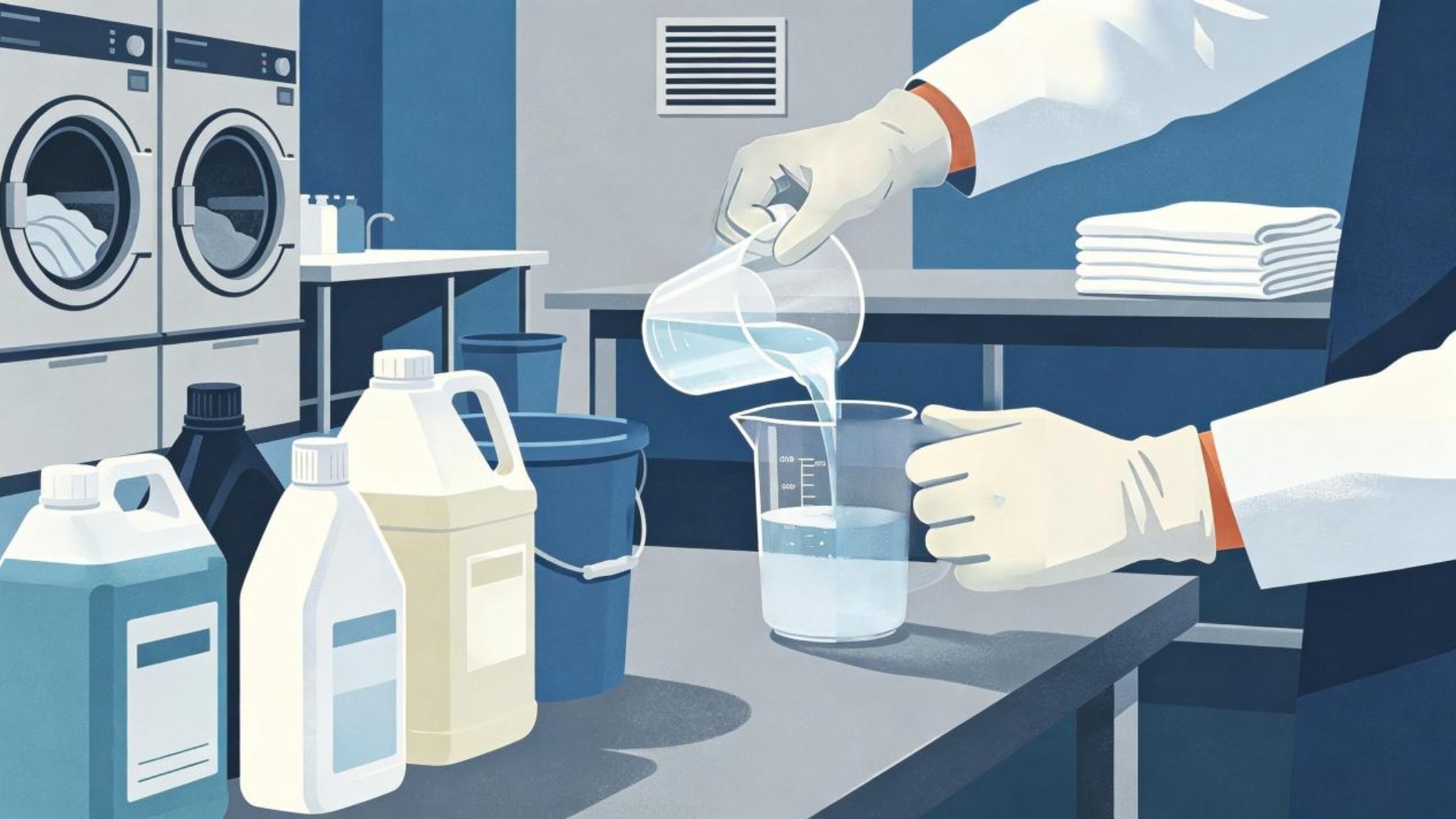
Chemical Safety Operation Standards
In workshops, chemical operations must follow unified safety standards. Do not perform unauthorized operations.
Do not closely smell chemicals. High-concentration volatile gases can easily cause respiratory injury.
Do not randomly mix different categories of chemicals. The mixing of acidic, alkaline, and bleaching detergents can generate toxic gases.
Do not dose high-alkaline agents into hot water. Rapid heat release can easily cause burns.
Do not lift or pour chemicals during handling or dosing.Otherwise, liquid splashes damage skin and eyes.
Wear acid- and alkali-resistant glovesand safety goggles. Wear a protective face shield when repairing chemical dosing piping.
Emergency response procedures:
● Chemical contact with skin
Constantly rinse with running water for 15 minutes.
● Chemicals splashing into eyes
Rinse with water for at least 15 minutes, and see a doctor immediately.
● Accidental ingestion
Do not induce vomiting without medical professionals.
Chemical Properties, Usage & Protection Tips
Mainstream laundry detergents and powders cannot be used together. They must be dosed in different compartments and cycles.
● Strong synthetic alkali/table linen detergent powder (highly alkaline)
They have strong corrosive properties. Manual dosing easily causes skin and eye burns. Check the dosing port after closing the flushing valve. Wear safety goggles first.
● Stain-removing acid powder(highly acidic)
Do not mix it with various high-alkaline chemicals. The combination of acid and alkali rapidly releases heat and generates irritating gases. When repairing dosing pumps, take protective measures.
● Oxygen/chlorine bleach powder
They cannot be used together. Clean residual chemicals before dosing. This prevents contact between different bleaching agents and chemical reactions.
● Alkaline booster/oxygen bleach/chlorine bleach/neutralizing acidsolution
The four chemicals cannot be mixed and dosed together. They should be dosed based on different wash cycles. Do not vigorously drag and pour liquid chemicals. When transferring residual chemicals to another container, strictly check labels to avoid chemical mixing.
| Name | Property | Safety Notes |
| Strong synthetic alkali/table linen detergent powder | Highly alkaline | Avoid contacting skin and eyes. Check the dosing port after closing the flushing valve. Wear safety goggles. |
| Stain-removing acid powder | Highly acidic | Do not blend it with alkaline detergents. Meet the same requirements as the above. |
| Alkaline booster solution | Highly alkaline | Be careful with transferring chemicals to containers. Wear a protective face shield and gloves when repairing dosing pumps. |
| Oxygen bleach solution | Mildly acidic/oxidizing | Do not mix it with alkaline booster solution, chlorine bleach solution, and neutralizing acid. Dose it at different wash cycles. |
| Chlorine bleach solution | Strong oxidizing/corrosive | Do not mix it with alkali, oxygen bleach solution, and acid. Take protective measures during operations. |
| Neutralizing acid | Acidic | Do not mix it with alkali, oxygen bleach solution, and alkaline booster solution. Carefully check labels when transferring chemicals. |
Kingstar Solutions for Reducing Safety Risks
Traditional manual opening of containers and dosing often causes safety accidents in laundry plants. Kingstar smart systems can achieve chemical safety management from three dimensions: hardware, automation control, and factory planning.
● Closed fully automatic chemical dosing system
It enables fully enclosed pipeline delivery. Operators do not open containers or come into contact with corrosive chemicals. The system doses chemicals based on linen weight and washing processes, which avoids liquid splashes and overdosing. It also reduces the risk of chemical burns to staff.
● Dosing design for tunnel washer systems
Chemicals should be dosed at different stages(pre-wash, main wash, bleaching, neutralization). The PLC program controls dosing time as well as sequence. Acidic, alkaline, and bleaching agents are dosed separately. This avoids generating toxic gases. This also reduces the risk of chemical mixing.
● Integrated chemical storage planning
Newly built laundry plants have independent chemical storage areas. Acidic, alkaline, and bleaching agents are physically isolated. Reserve areas for emergency rinsing as well as leakage treatment. Clear labels should be used for pipelines to ensure daily safety management.
● Digital chemical inventory management
Record the consumption time and dosing sequence of each container. Traceable data is convenient for plants to establish a chemical safety inventory. This meets the requirements of safe production and eco-friendly supervision.
Long-Term Management Methods
Store chemicals in different areas. Separate highly acidic, highly alkaline, and cleaning agents. Containers can be stored with risk warning labels.
Conduct safety training for staff. They should clearly know chemical usage and emergency rinsing procedures.
Healthcare laundry plants should strengthen management. Bleaching and highly alkaline agents should be dosed automatically. This can reduce manual operations.
Check pumps as well as dosing pipelines. Fix any leaks in time.This avoids chemical corrosion.
Q&A
Q1: Can chlorine bleach powder and neutralizing acid be used together?
A1: No. Mixing may generate toxic and irritating gases. They should be dosed in different wash cycles.
Q2: Can strong laundry powder be used for household washers?
A2: No. It has high alkalinity. So, it is only suitable for tunnel washer systems as well as heavy-duty industrial washers.
Q3: What issues can excessive softener cause?
A3: This can cause yellowing as well as a sticky feel. Laundry plants in hard water areas should reduce the dosage.
Post time: Sep-03-2026