
Nowadays, the global laundry industry faces many challenges: rising costs, homogeneous competition, and refined customer demands. Traditional business models, depending on scale expansion and price competition, have reached their limits. Building irreplaceable service barriers and earning the long-term trust of high-end customers have become core challenges for professional laundry plants.
RFID-tagged linen is far more than a hardware upgrade. It helps laundry plants embrace digital management. It aims to reshape cooperation models and value exchange between laundry factories and hotel clients.
As an automated laundry equipment manufacturer, Kingstar has much experience in the laundry industry. It is committed to combining hardware equipment (tunnel washer system, high-speed ironing line, and smart overhead bag conveyor system) with data-driven and IoT platforms. This helps provide “visible, measurable, and value-added” integrated solutions for customers.
Kingstar finds that customers who successfully use chip technology have undergone the following transformation.
Visible Process
Under the traditional service model, linen enters a “black box” after leaving hotels. Washing results rely on the final random inspection and long-term business relationships. Inconsistent standards and poor communication are prone to causing disputes.
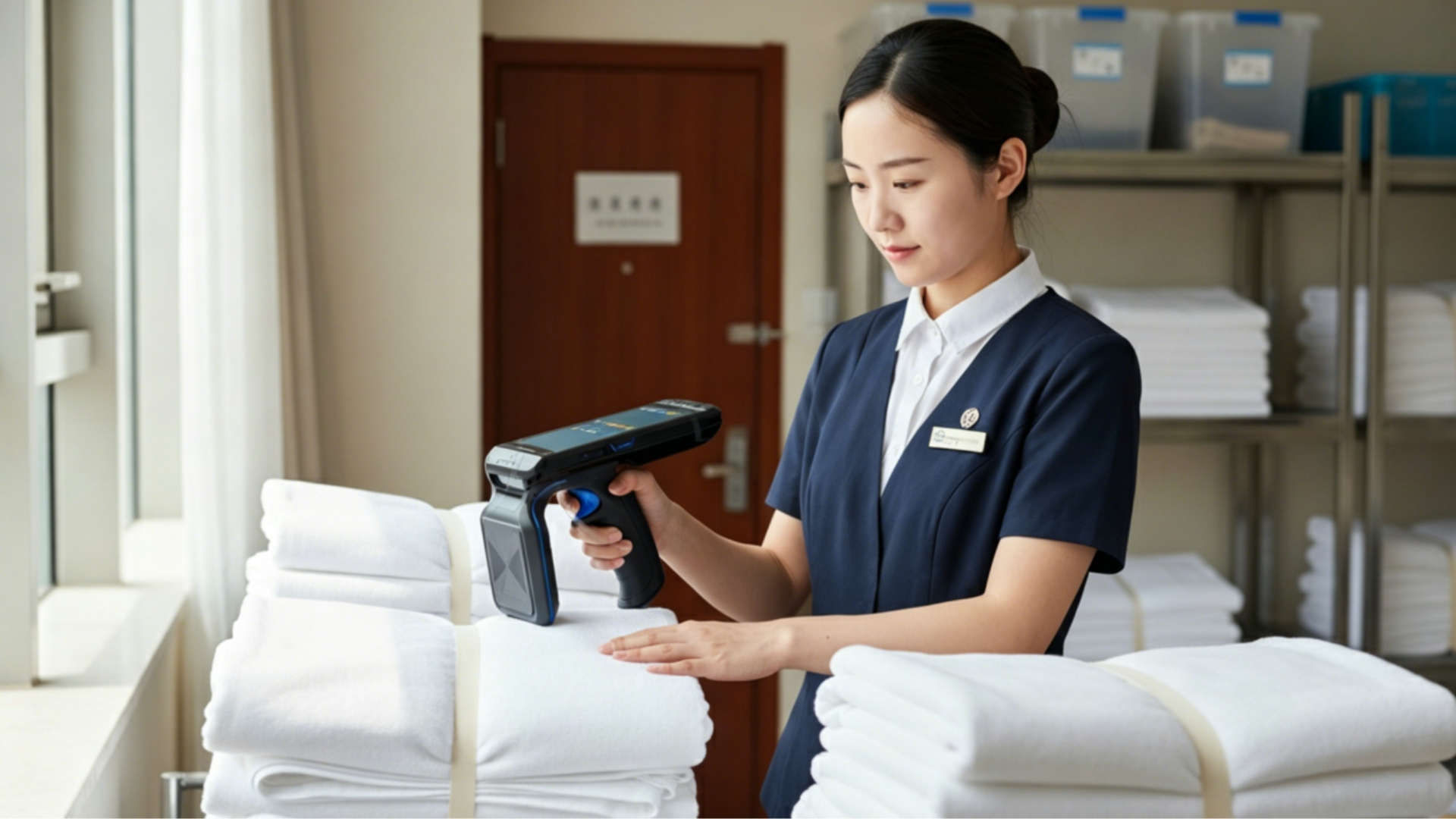
Due to chip technology, every linen item can be tracked during the entire laundry process. Parameters, including temperature, mechanical processing time, and operators, are automatically captured and connected with the linen.
Therefore, hotel clients can log in to the visible dashboard through security permissions. This allows them to see the current status and full processing cycle of linens in real time. It is like a 24-hour transparent workshop which supports multiple languages in laundry plants. It turns invisible services into visible data.
Standardized Model
In the past, settlement based on kilograms or pieces cannot precisely reflect laundry plants’ investment in compliant disinfection, gentle processing, and high-standard ironing. This makes it difficult for better services to command premium pricing.
The data-driven process brought by chip technology promotes innovation in settlement models. Laundry plants can preset the process requirements (such as the temperature-time combination for killing specific pathogens) of each cycle with customers. Systems can automatically verify the turnover data of each batch of linen. Once all requirements have been met, the settlement order will be completed.
For hotels, this “performance-based settlement” model ensures that each expense corresponds to clear and qualified service. Returns on investment are visible. For laundry plants, this model directly transforms the quality advantages of equipment (high-end tunnel washer system and high-speed ironing line) into fair returns. It motivates the industry to shift from price competition to value competition.
Data & Closed-Loop Management
Physical assets (such as equipment brand and capacity) are easy to imitate. But they cannot survive for a long time. The digital advantage started by the “RFID linen tracking system” builds multiple layers of competitive advantage.
Smart laundry plants can build an assessment system based on the following dimensions. It is difficult to be replicated by competitors in a short time.
● Full-process traceability
Customers can monitor every cycle whenever possible. The system ensures a high tracking rate.
● Quality anomaly alerts
The system automatically identifies linens which deviate from process standards. It connects them with the relevant equipment, workers, and consumables. This helps quickly identify the root cause.
● Cross-customer linen mix prevention
During the sorting or collection, and delivery stage, RFID readers automatically alert the linens belonging to other clients. This avoids linen mix-ups and guarantees customers’ asset security.
● Life cycle management
The system can precisely record the wash count of each linen. Combined with historical washing data, it predicts its remaining service life, providing scientific suggestions on linen purchasing and replacing for customers.
Shared Value
When the process is transparent and settlement is fair, the cooperation between laundry plants and hotels can shift from “unit price” to “shared value”.
● Lower hotel operational risks
Verifiable disinfection and laundry process significantly reduce customer complaints and brand reputation risks caused by linen hygiene problems.
● Improve hotel management efficiency
Automatic account check and stock management (real-time visibility of linen in store, washing, and on delivery) reduce administrative workload in hotel logistics.
● Drive hotel sustainability
The system provides precise data reports based on linen and utility consumption. Hotels can cut costs and meet their sustainability goals.
Q&A
Q1: Does chip technology impact the service life and laundry results of linens?
A1: Absolutely not. Today, RFID laundry-specific chips are widely used in the laundry industry. They are made from flexible packaging technology. They have better resistance to high temperatures, high pressures, corrosion, and bending. They can tolerate the strict environment of industrial laundry and high-speed ironing. The chips last longer than the service life of the linens themselves. Chip packaging is lightweight and flexible. Chips are sewn and heat-bonded on the linen tags or hidden areas. There is no negative impact on the touch, appearance, and laundry process of linens.
Q2: How long does the return on investment period of the smart linen system take?
A2: The time varies based on the scale of the plant, the existing level of automation and customer structure. The payback period is one to three years. Automated systems allow plants to control over the linen usage and stock. This helps reduce losses and improve daily operations. Reliable services also bring customer loyalty and support long-term business relationships.
Q3: Should hotel clients incur extra costs or integrate with complex systems?
A3: Hotels don’t need to invest in large hardware. They access data through an encrypted web platform or mobile SaaS platform. Laundry plants can improve their competitiveness through this value-added service. It is convenient to use the interface. Overall, hotels gain a better user experience with minimal costs.
Post time: Jun-09-2026