
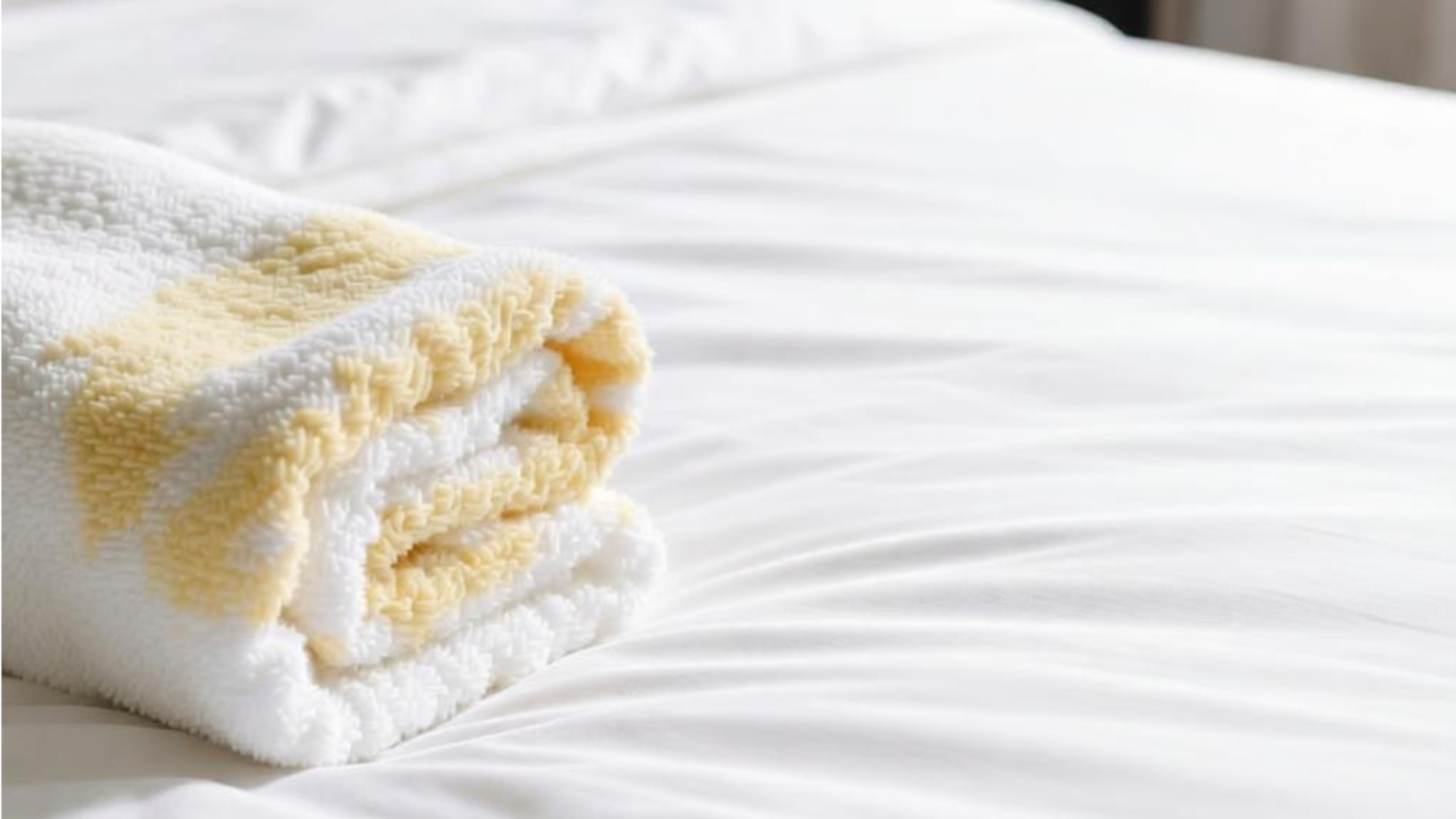
In the linen laundry industry, the lasting whiteness of white textiles and light-colored textiles is the core indicator of professionalism. Yellowing not only damages the beauty but also directly shortens the service life of the linen and causes economic loss. To systematically solve these problems, people must scientifically know the causes and precisely control the washing, ironing, and storage processes.
Five Reasons for Yellowing
● Light-induced Yellowing
It is caused by fiber oxidation from sunlight or ultraviolet rays. It has a big impact on bleached or brightened linen in particular. Long-term storage near windows will heighten this risk.
● Phenolic yellowing
BHT, an antioxidant in packaging materials (e.g., cartons, films), reacts with nitrogen oxides in the air to form yellow substances. It is the most common static yellowing issue during storage and transportation.
● Oxidative yellowing
It is caused by oxygen, ozone, or residual chlorine and peroxides from washing. Improper water quality, chemicals, and washing processes are the primary causes.
● Optical brightener-induced yellowing
Overuse or use of low-quality optical brighteners may lead to their migration and local accumulation during storage, which instead causes uneven yellowing.
● Yellowing from softeners & finishing agents
Ingredients in cationic softeners and similar products may oxidize and yellow under high-temperature ironing, light exposure, or long-term storage.
Scientific Judgment
Assessing linen’s anti-yellowing performance needs standardized tests.
● Light yellowing test (e.g., GB/T 8427)
● Phenolic yellowing test (e.g., GB/T 29778)
● Chlorine bleaching yellowing test (e.g., FZ/T 01078)
Reviewing relevant test reports when procuring linen is an important step in risk control from the source.
CLM Systematic Solutions
Prevention of yellowing is a systematic process. CLM, as an intelligent laundry solutions supplier, helps customers avoid risks in the full process with intelligent equipment and scientific management.
● Intelligent Laundry
Laundry is the core link. The CLM tunnel washer system can achieve precise control through high automatic design. Intelligent dispensing systems ensure that the precise addition of all kinds of chemicals is according to the preset programs. This can avoid residues and bad impacts. The precise control of chlorine bleaching agents is very important.
● Optimize the process parameters
According to different textiles and stains, the best water temperature and time should be achieved to avoid over-treatment.
● High-efficiency counter-current rinsing
Its countercurrent rinsing at the bottom of dual chambers and other designs can greatly reduce the residue of detergent and impurities. This is a good foundation for the following treatment.
● Post-wash finishing
It is a high-incidence area for thermal yellowing and yellowing of finishing agents. The CLM solution emphasizes a balance between efficiency and mildness.
● Precise temperature control
CLM high-speed ironer and chest ironer have a precise temperature control system that can ensure the smoothness and avoid yellowing and fiber damage caused by high temperature.
● Usage of chemicals
Professional finishing agents with excellent anti-yellowing performance should be used, and people should avoid excessive residue.
● Storage and transportation
- Clean air
The storage area should be ventilated and clean to reduce the accumulation of contaminants.
- Standard packing materials
People should be limited to using packaging materials that do not contain phenolic substances such as BHT.
- Scientific storage management
Linen storage should be ventilated, dry, and avoid light. It should also follow the principle of “first in, first out”.
● Water quality and chemical management
- Water quality monitoring
People should regularly test the hardness and iron ion content of the washing water, and configure water treatment equipment when necessary.
- Chemicals selection
People should choose the yellowing resistance and specialized materials.
- Process customization
People should customize the washing process according to the characteristics of the linen composition with besmirch.
Conclusion
Yellowing is a complex issue caused by many factors, but it can be controlled by establishing full-chain quality awareness. Procurement acceptance, washing, processing, and storage management are all very important. By adopting the CLM intelligent tunnel washer system, ironing linen with precise temperature control, and scientific process management, the anti-yellowing awareness can be turned into controllable parameters. This helps avoid yellowing, ensures linen quality, and improves customer satisfaction. Also, it helps achieve cost reduction, efficiency increase, and sustainable development.
Q&A
Q1: What kind of yellowing is it when regular yellow spots appear at the folding points of the linen in the warehouse? How to prevent it?
A1: This is a phenolic yellowing. The prevention is as follows.
- Use acid-free paper or PE film without BHT.
- Keep ventilated, dry, avoid light, and away from the nitrogen pollution sources.
- Preferred hanging storage, reducing the pressure of folding and closed contact.
Q2: Which operational errors in the water washing process are most likely to cause oxidation and yellowing?
A2: improper use of chlorine bleaching agent: adding too much, the water temperature is too high (> 70℃), or direct contact with acid.
Feeding program error: bleach not fully diluted or delivery order mistakes, causing high local concentration.
Rinse incomplete: result in alkali, oxidant, or residual impurities such as iron ions.
Quality problem: using hard water or water containing iron, manganese ions, can easily lead to yellowing sediment forming attached.
Q3: The linen has turned yellow. What are some emergency rescue methods?
A3:
Phenolic yellowing: try to use the insurance powder (sodium dithionite) or special phenolic yellowing remover for reduction treatment, and after processing must be fully rinsed.
Oxidation/yellowing chlorine bleaching: try to use a low concentration (1-2%) sodium bisulfite solution for reduction of washing. Chlorine bleach must not be used again.
Metal pollution yellowing: using oxalic acid or professional metal chelating acid pickling at low temperatures.
Gm to deal with the yellow: the complex causes or slightly yellow, hydrogen peroxide (hydrogen peroxide) for use in high temperature (> 80 ℃) and alkaline conditions after bleaching, and then add brightener.
Important: all saving measures need samples to test first, after the success of batch processing. The fundamental lies in establishing a prevention system.
Post time: Jan-29-2026