
In the industrial linen laundry sector, many laundry plants have a misconception. They focus more on chemicals than on processes. For common stains (such as linen yellow stains, rust stains, and stubborn blood stains), operators address these issues by blindly increasing chemical dosage and using different chemicals. This can increase laundry costs. It can also cause chemical residues and water waste. It is more likely to damage linen fibers and shorten linen service life. Some stains may even become set in the fibers.
In fact, the key to linen cleaning performance is not chemical quality, but precise stain identification, targeted chemical dosing, proper temperature control, and standardized processes. Kingstar is a professional manufacturer of automated laundry equipment and a laundry plant system integrator. It has been deeply involved in the laundry industry for many years. It provides complete smart equipment, including tunnel washer systems, high-speed ironing lines, and overhead bag conveyor systems. With abundant front-line laundry experience, Kingstar develops standardized stain treatment solutions. These solutions can address various laundry issues at the source. Laundry businesses can achieve efficient, energy-saving, high-quality, and standardized laundry production.
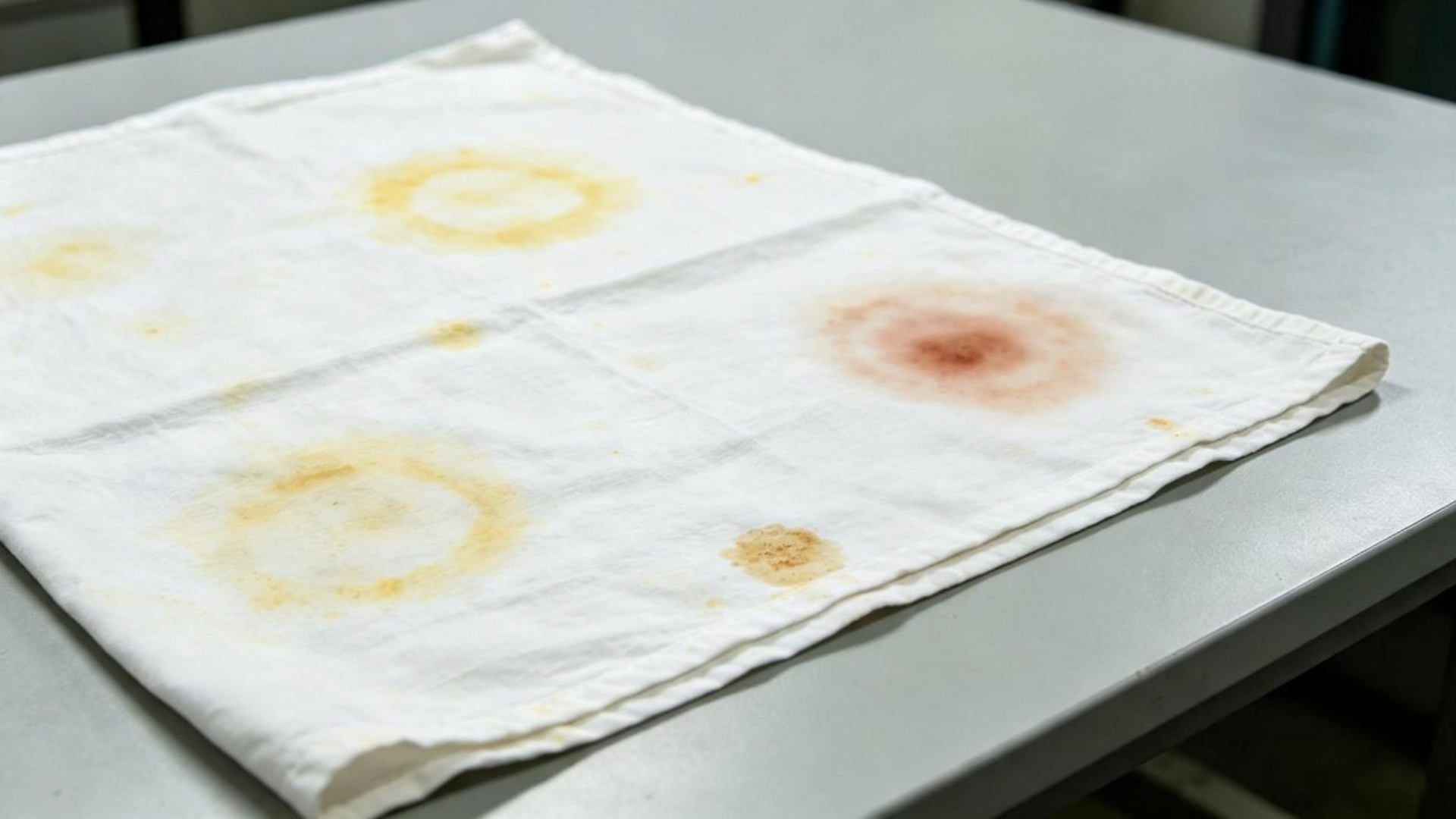
Standardized Treatment for Linen Yellow Stains
Yellow stains often appear on industrial linen. They are caused by multiple factors (such as water impurities, chemical residues, and contamination from equipment deposits). Different yellow stains require different removal methods.
● Rust stains
Reddish-brown rust stains are caused by iron in the water. They may be caused by rust particles from equipment pipes. This is common in many laundry plants. Operators often remove these stains with chlorine-based bleach. However, this can set stains. It may even lead to linen disposal.
Solution:
Use rust removers/acidic stain removers. Soak the stained linen in 40-50℃ water. Thus, rust stains can be dissolved and removed. Then rinse the linen with clean water. Use a neutralizing acid to adjust the pH. This can help the condition of the fibers.
Notice:
Do not use chlorine-based bleach. This may oxidize rust stains. They can become more difficult to remove. The stain color can become darker. This can cause irreversible damage. Kingstar tunnel washer system has a smart chemical dosing and a zone-based temperature control system. It can automatically adjust temperature and chemical dosage. This can reduce manual operation errors.
● Yellowing caused by alkali residues
Linen can become yellow and stiff without sufficient rinsing. This can even cause linen damage and aging.
Solution:
Rewash linen with 40-50℃ water. The neutralizing acid dosage should be increased by 50% compared with the daily standard. Soak linen in the solution for at least 10 minutes. This can neutralize alkali residues inside fibers. Yellow stains can gradually be reduced. Linen will regain its softness. Do the finishing procedures after rinsing.
● Yellowing caused by softeners
Linen may have a localized dull appearance. It may also be greasy and sticky. This is often caused by softener oil film attached to fibers. Softener buildup inside dryers and ironing machines can cause re-contamination.
Solution:
Use a 60-70℃ washing process, rather than low-temperature washing. Add strong-alkaline detergents and emulsifiers. This can remove oil residues from the fiber surface. Residual softeners can also be removed at the source. Linen can restore its cleanliness and brightness.
Standardized Laundry Process for Stubborn Blood Stains
Blood stains are protein-based organic stains. They are difficult to remove from linen. Many laundry plants use high-temperature washing. However, protein can quickly coagulate when exposed to heat. They can become trapped inside fibers, becoming permanent marks. Kingstar smart laundry system uses programmable temperature control and a time-based dosing system. It can support a blood-stain-specialized laundry process. This can efficiently remove stubborn blood stains.
Core principles:
Full-process cold water pre-treatment, low-temperature main wash
Do not use high-temperature washing. Use a protease-based blood stain remover.
Steps:
● Low-temperature prewash
Keep the water temperature under 20℃. Do not add any chemicals. Flush away loose blood residue on the linen surface. This can reduce the secondary spreading of stains.
● Precise main wash
Dose protease-based blood stain remover powder. The main wash process should be done in 30-40℃ water for 10-15 minutes. This can decompose protein-based blood stains inside fibers.
● Color removal
A 40-50℃ oxygen bleaching process can gently remove color. This also helps protect linen fibers.
● Neutralization
A neutralizing acid can adjust the pH. This can make linen cleaner.
● Special treatment for old blood stains
Add protease to cold water. Soak stained linen in the solution for 1-2 hours. Stubborn stains can be broken down. Then do the main wash.
Q&A
Q1: Can low-quality chemicals remove all stains from linen?
A1: No. This can be affected by many factors (washing processes, chemicals, and temperature). For example, excessive chemicals can increase costs. It may also damage linen. Thus, the key to cleaning is precise identification. Meanwhile, follow the standardized procedures.
Q2: Can rust stains be removed with chlorine bleach?
A2: No. Chlorine bleaching can oxidize and fix rust components. Rust color can become darker. Rust stains will be attached to fibers permanently. They cannot be removed later. Use a rust remover and a neutralizing acid process.
Q3: Can blood stains be removed with hot water?
A3: Protein is the key component of blood stains. It can rapidly coagulate when exposed to high temperatures. They can become trapped in fibers, which forms irreversible marks. They are harder to remove. Thus, a low-temperature washing process is recommended.
Q4: What can cause linen stiffening and yellowing?
A4: Alkali residues or softener buildup. Double neutralizing with acid and low-temperature soaking can restore linen appearance. Softener residues can make linen dull and greasy. These stains can be removed through high-temperature, high-alkaline washing with emulsifiers.
Post time: Oct-06-2026