
Many industrial laundry plants often encounter linen damage issues. They need to compensate hotels for damaged linen. So why is linen damaged? How can laundry plants reduce damage? This article will introduce some practical steps to identify and reduce linen damage.
Pinhole Damage
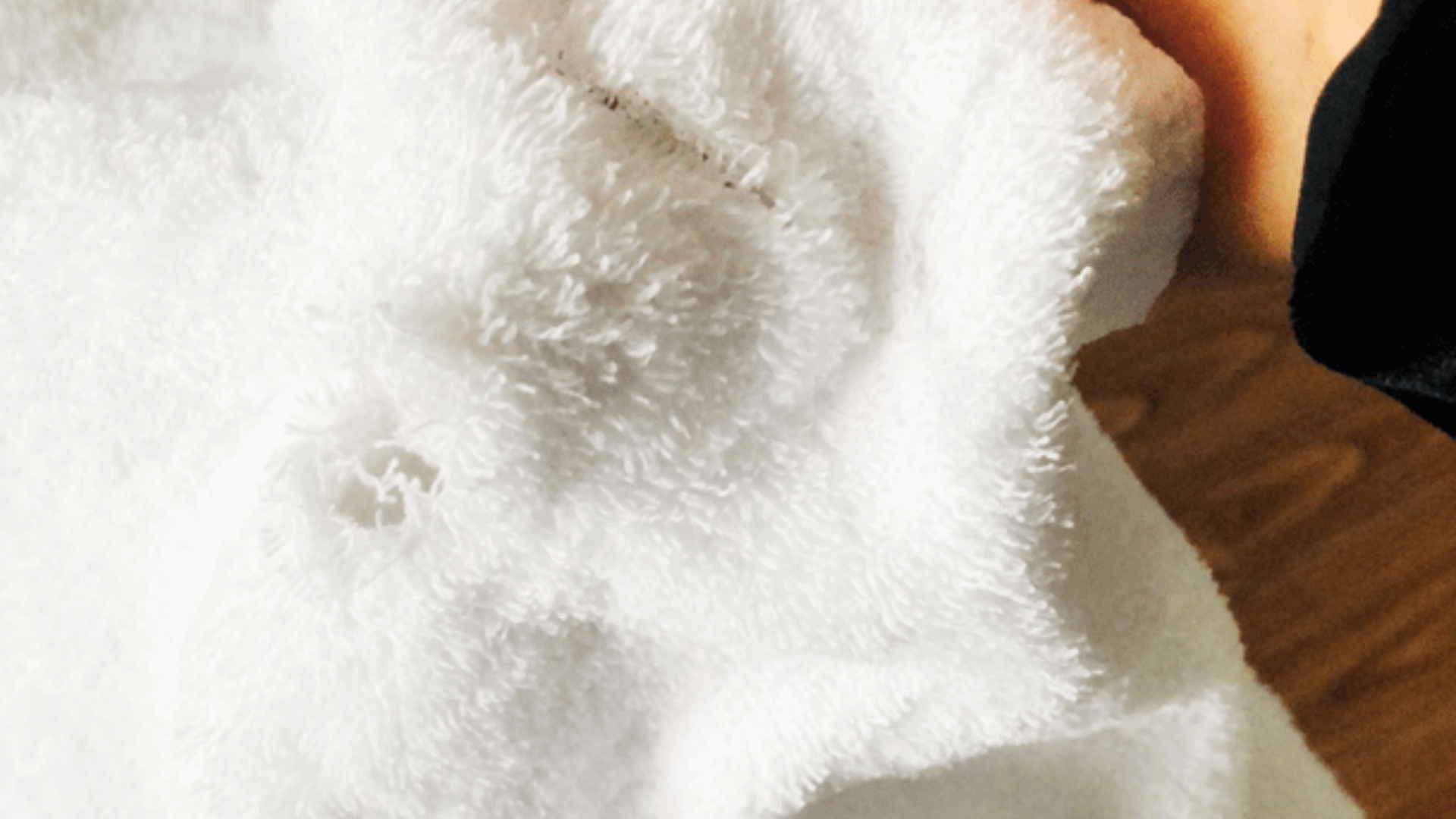
Pinhole damage is the most common one. Broken holes are round or nearly circular. They have different sizes and unfixed positions.
Many laundry plants think pinholes are made by bugs. However, they may also be caused by chemical corrosion. Here is an identification tip: take a photo and enlarge it to see. If they are caused by chemical corrosion, blurred spreading marks may occur at the edge of broken holes, like ink dropping on paper. The surrounding fabric fibers of holes become brittle and fuzzy. Seriously, the surface fibers may disappear, leaving warp and weft yarns. They easily break with a touch.
After confirming broken holes are caused by chemical corrosion, focus on checking two areas.
– Heavy soil treatment
When handling heavily soiled linens, many laundry operators directly apply chemicals (especially strong alkali and powerful stain removers) onto dry linen. They may not rinse the chemicals with water in time. Excessively concentrated chemicals directly burn the fibers. After washing, many pinholes appear on the linen.
During the heavy soil treatment, wet the linen before dosing chemicals. Operators can also dilute chemicals first. The reaction time between chemicals and stains should be based on the product instructions. After reaching the limited time, promptly use clean water to remove chemical residues.
– The dosing inlet of main wash chemicals
If the dosing inlet is improper, chemicals may directly spray onto the linen rather than mixing with water first. A Kingstar 100 kg industrial washer has an automatic dosing inlet. It can dose chemicals into detergent compartments in advance. Chemicals completely mix with water before entering the inner drum. Connecting with chemical dispensers is also convenient.
Right-angle Damage
The damage is often in a straight line, a right angle, or an “L” shape. The edge is even, unlike frayed edges caused by tearing.
This type of damage includes two cases. They have different troubleshooting approaches.
● Regular damage locations
Multiple linens from the ironer have broken holes about 30 centimeters from the edges or on the same corner. It is almost certain the problem is the ironer.
– Check if there are foreign objects on ironing belts
Carefully check the surface of ironing belts after shutdown to see if there are sharp objects like wire ends, staples, and glass fragments inside. These little things may come from linen bags. They may get stuck in the ironing belt before damaging the linen. Fixed positions lead to regular cuts.
– Check if there are burrs or gaps on guide rollers and pressure plates
Rust spots and burrs may appear on the surface of guide rollers. Pressure plates may also have gaps at the edges. They lead to orderly and straight cuts on linens. Gently touch along the direction of the linen. The problem area lies in the rough hand feel.
Promptly remove foreign objects. Replace the heavily damaged ironing belts. Polish and smooth the burrs on guide rollers with sandpapers. Reweld the gaps on pressure plates and then grind and smooth them.
● Irregular damage locations
Cuts appear on different areas of the linen. Systematic inspection is required for the entire production line.
– Discharge outlets of washers/tunnel washers: sharp corners or burrs.
– Dryers: welding slags or burrs in inner drums/broken sharp corners in drum lifters.
– Conveyor lines/belts: raised metal clips at belt interfaces.
– Manual handling/logistic turnover: whether burrs on linen carts scratch door frames or cart corners during the loading and unloading process.
Use an old light-colored towel to move slowly along the doubtful areas. The problem area can be found by the snagging or broken towel point. This is more efficient than seeing.
Crease Abrasion Damage
This type of damage is special. It is not a hole or a cut. It is in a folded or rubbed shape. The linen looks as if it is twisted or rubbed. Fibers break at the creases, forming a row of parallel small gaps and fabric fuzzing or thinning in a large area. This may be caused by membranes of press extractors.
A press extractor removes water from the linen by membrane expansion. If the membrane is in a poor state, the linen is not pressed but rubbed.
– Water volume during transfer
When the linen enters from a tunnel washer to a press extractor, insufficient water leads to knotting and entanglement. Uneven pressure easily damages the linen. It is prone to causing issues with high-tensile tablecloths and napkins.
– Membrane water volume
Insufficient water or air mixture leads to uneven membrane expansion. Some areas are hard while others are soft. During the process, the linen slips and mismatches to form a rubbing effect. This can also be judged by listening. Normal pressing produces a steady squeezing sound. If there is a bubbling sound, that indicates air enters the membrane. It needs to be released.
– Membrane shape
After long-term use, the membrane ages. Some areas become thin and bulging. The entire membrane may be off-center. Uneven pressure can damage the linen. After shutdown, open the press extractor to check for visible bulging, scratching, or uneven wear marks.
– Press basket shape
The drop between the outlet of the tunnel washer and the bottom of the press basket may exceed more than 1 meter. The linen impacts the press basket for a long time. The press basket tends to deform without sufficient strength. Once deformed, the membrane becomes misaligned with the press basket while pressing down. So the linen sticks in the gaps between the membrane and the press basket. Prolonged high pressure damages the linen. The wall thickness of a Kingstar press extractor reaches up to 26 mm. It can withstand long-term high pressure. So when selecting a tunnel washer, laundry plants should care about these details.
Irregular Frayed-edge Damage
Some damaged linens may have irregular shapes with frayed edges and loose fibers. They also look old, thinner, and yellow. This may not be caused by the equipment. The linen itself has reached its service life.
The linen has its own lifespan. After repeated washing, high-temperature ironing, and mechanical stretching, the strength of cotton fibers gradually declines. They may break with a slight force when reaching their lifespan. The cuts are uneven, not like those caused by equipment.
How to decide whether the linen should be changed or not?
– RFID-tagged linen
Currently, many hotel linens are tagged with RFID tags. Data like wash count and service life is visible in the management system. Generally, the lifecycle of cotton bed sheets and duvet covers is around 150 to 200 times, while tablecloths and napkins are around 100 to 150 times. This is based on the linen quality and usage scenarios.
– Ordinary linen
After having problems with linen damage, laundry plants should promptly troubleshoot the causes and conclude. So they can gradually develop their experience. They can reduce linen damage at the source. This not only improves customer satisfaction but also reduces operational costs.
Q&A
Q1: How many times can RFID-tagged linens withstand high-temperature wash cycles? Can they match the lifespan of the linen?
A1: Most industrial RFID-tagged linens can be physically washed for about 200 to 300 times. This meets the laundry demands of most hotel linens, such as regular washing, drying, and ironing. They can often withstand the 90℃-200℃ temperature and chemical corrosion. But during the data reading process, some linens that can not be identified should be found out and replace RFID tags.
Q2: Can a gas-heated dryer accelerate the aging and damage of towels?
A2: Traditional gas-heated dryers may have excessive heating intensity and temperature. This may cause linen stiffness and accelerate damage. Kingstar direct-fired pass-through dryers use a flameless direct-fired heating technology and a moisture control system to avoid such situations.
Q3: What is the energy consumption of a Kingstar direct-fired pass-through dryer?
A3: For drying 120 kg of towels, it consumes only 7 m3 of gas.
Post time: Jul-31-2026