
In the commercial linen laundry industry, most operators share similar goals: control investment, reduce space requirements, reduce labor, and reduce energy consumption. The laundry industry is a service business with thin profit margins. It focuses on operations and relies on stable processes. However, the industry has a misconception: high efficiency and low costs mean cutting costs to the limit. This can make equipment, staff, facilities, and production capacity overloaded. This can leave no room for operational flexibility.
This aggressive cost-cutting method seemingly provides low investment and high capacity utilization. Actually, it hides large operating risks. Rigid production systems fail to address emergent issues, such as fluctuating orders, equipment failures, staff turnover, and customer growth. The visible costs saved in the short term can cause more hidden problems (equipment shutdown, customer complaints, linen damage, and reputation loss). This is also the core reason why most laundry plants seem to be run at full capacity but make small profits.
Disadvantages of Excessive Cost-Cutting
● Misunderstanding production efficiency
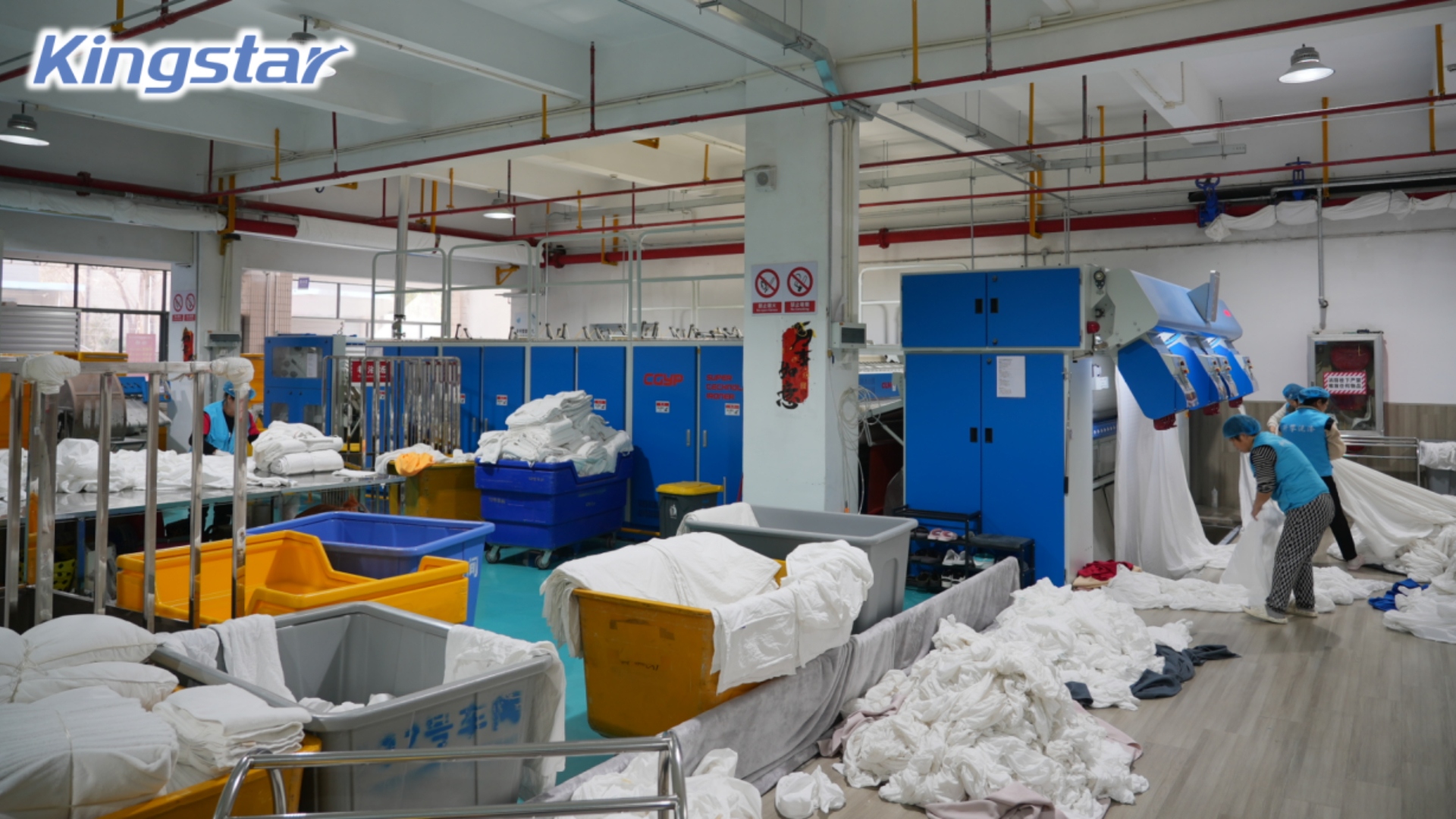
Commercial laundry efficiency is not about a single machine, but an entire production system. From soiled linen collection, sorting and washing, ironing and folding, storage and distribution to clean-linen delivery, the production process is closely connected. A single workflow disruption can cause bottlenecks across the line.
During the initial planning period, many laundry plants only focus on superficial parameters, such as the laundry equipment capacity and the rated speed of ironing lines. They overlook key points, such as loading during peak seasons, rewash fluctuations, equipment maintenance periods, capacity differences during off and peak seasons, and different customer demands. During stable operations, these risks can be invisible. Once laundry plants enter peak seasons, capacity bottlenecks as well as process problems can emerge.
● A series of operational risks
Without backup equipment, sudden equipment failure can cause a complete production shutdown and a huge linen backlog. Insufficient capacity for ironing and sorting can also cause linen buildup. This can significantly increase re-contamination, linen mix-ups, as well as misallocation. To meet the delivery deadline, overworked employees relax quality control standards. As a result, unqualified linens (such as wet, damaged, and stained linen) are sent to customers. For laundry businesses that serve high-end hotels and chain brands, one customer complaint or one delivery accident can affect the profit of a single order. These issues also damage long-term accumulated customer trust and brand reputation.
● Limit large-scale operations
There is a common mindset in the laundry industry. Damaged equipment can be repaired. Add equipment after orders increase. Recruit temporary employees due to staff vacancies. This short-term method is suitable for scattered businesses. It cannot support large-scale, standardized modern laundry plants.
The loss of large-scale operations can be delayed. Short-term cost savings cannot compare with long-term hidden losses. Reducing equipment redundancy can save purchase costs. However, this can also increase maintenance, overtime, and outsourcing costs, as well as contractual penalties. Improper plant workflow and storage space can save rental costs. But it can reduce handling efficiency as well as increase cross-contamination and production safety risks. Staff reduction can lower labor costs. But it may cause frequent staff turnover, increased training costs, and unstable laundry quality.
● Hidden losses caused by linen wear and loss
To reduce laundry costs per kilogram, some laundry plants simplify wash programs, reduce rinse cycles, and use low-quality consumables. They may also increase capacity through high-temperature drying and high-pressure ironing. Short-term cost per square meter can be reduced. However, this can accelerate linen graying, yellowing, stiffening, and damage. It can significantly increase linen loss rate. Customers do not calculate the details of losses. They often reduce orders or replace service providers. This can lead to the loss of long-term customers.
Approaches to Achieve Sustainable Profitability
A modern laundry plant that can achieve sustainable profitability does not cut costs to the limit. The key step is proper redundancy and balanced processes, such as moderate equipment redundancy, efficient plant workflow layout, sufficient storage buffer space, backup staff for key positions, as well as complete maintenance and emergency plans. They can reduce operational risks and ensure consistent delivery.
To achieve true efficiency, laundry plants should maintain normal production conditions. During peak seasons, production can remain stable. The process can also run smoothly when unexpected disruptions occur. Besides, total operational costs (equipment lifespan, rewash rate, customer complaints, linen wear and loss, and staff turnover) should be optimized, rather than temporary single-cycle cost-cutting.
Today, the Chinese laundry industry is transforming from extensive models to standardized, smart, and high-end production. Traditional production relies on manual operations, limited equipment capacity, and excessive cost-cutting. It cannot meet the strict laundry standards and stable delivery demands of high-end hotels, medical institutions, and high-end restaurants.
Kingstar is a professional smart laundry plant system integrator. It has been deeply involved in the industrial laundry industry. It focuses on the R&D and manufacturing of key equipment (tunnel washer systems, high-speed lines, and smart overhead bag conveyor systems). Meanwhile, Kingstar can provide overall smart laundry plant planning, process optimization, and entire production workflow solutions. With systematic and smart designs, it can help customers build stable production systems. This helps them balance their production capacity, laundry quality, energy consumption costs, and operational resilience. Therefore, customers can move away from low-price competition. They can achieve long-term stable operations and sustainable profitability.
Q&A
Q1: Why do laundry plants not make profits when reducing equipment, site, and labor costs?
A1: Excessive cost cutting leaves no redundancy or buffer capacity. This can easily cause hidden risks (such as equipment shutdown, decreased quality, customer complaints and compensation costs, and linen wear and loss). Long-term comprehensive costs far exceed the initial investment. This can significantly affect plant profitability and reputation.
Q2: What is key to true efficiency of modern laundry plants?
A2: It does not mean equipment runs at full capacity. Laundry plants should ensure stable, normal production. During peak seasons, the production capacity should be sufficient. Unexpected failures can be controlled. The entire process can run smoothly. This can ensure consistent quality and reliable delivery.
Q3: How can Kingstar help laundry plants balance efficiency, costs, and stability?
A3: Kingstar provides complete smart equipment. It can also offer overall plant planning services. Thus, customers can properly configure equipment, optimize production workflow, and build smart end-to-end processes. This helps them control energy consumption and operational costs. Therefore, laundry plants can improve operational resilience as well as washing quality. They can maximize long-term total returns.
Post time: Sep-22-2026