
This article is about the rest pain points.
Linen Treatment Before the Spreading Feeder
In the production process of laundry factories, every link directly affects the overall efficiency and quality. However, in many factories, the linen handling process before the spreading feeder still has many inefficient steps. This problem not only increases the labor costs but also has a bad impact on the linen quality and linen service life.
● Problem 1
In some laundry plants, after the linen is conveyed to the spreading feeder area via conveyor lines, it often falls directly to the ground. From this moment on, the linen is at risk of being contaminated again. Linen that should be kept clean can easily cause secondary pollution when it comes into contact with the ground. This affects the hygiene quality and leads to an increase in rewashing and washing costs.
Also, when the linen is transferred between different workstations, it still needs to be moved again. Each picking and turnover increases labor input and reduces overall efficiency.
● Problem 2
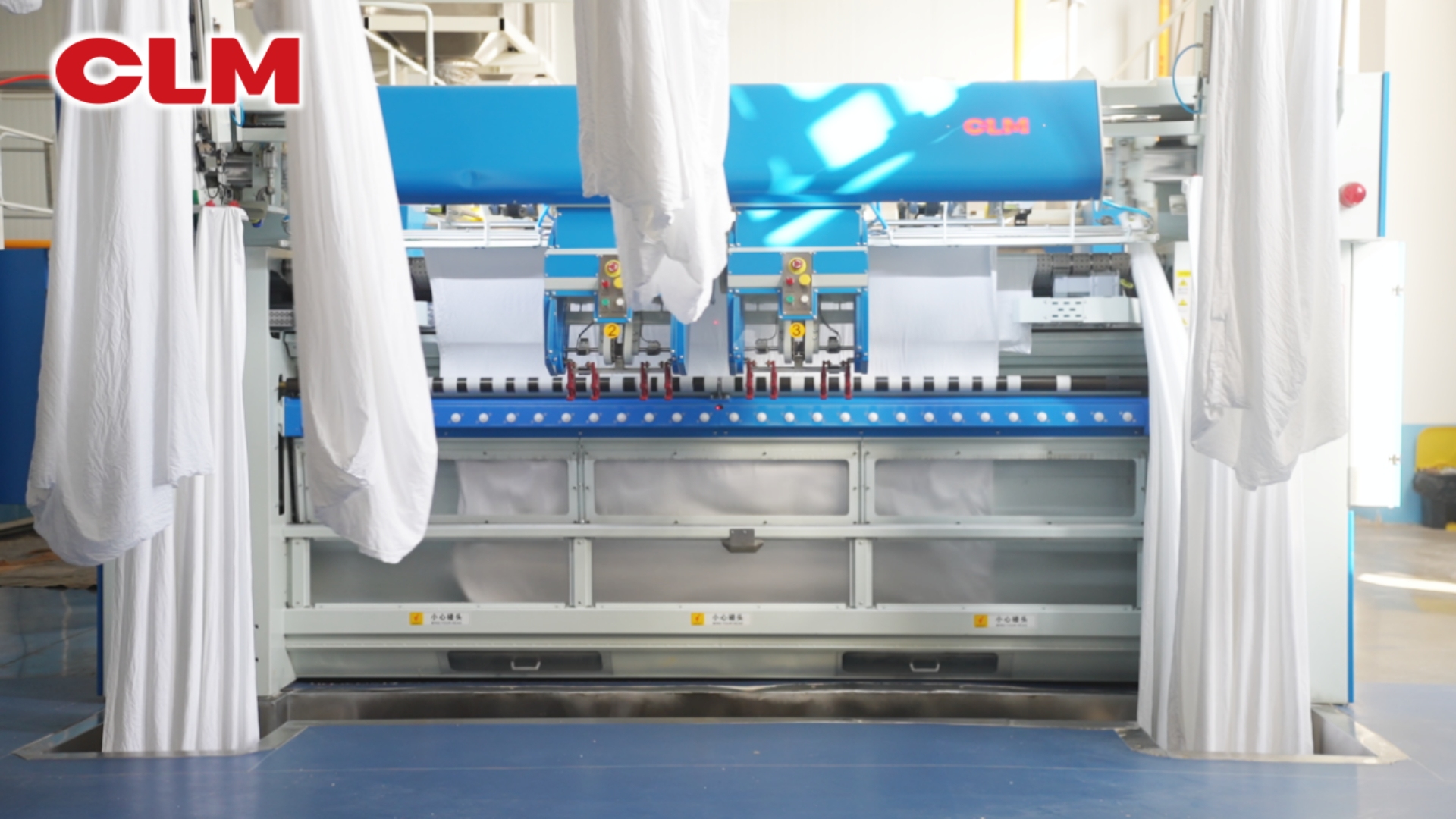
The linens coming out of the dryer often get entangled with each other, just like a tangled ball of thread. As a result, many laundry plants have to arrange dedicated personnel to unravel and distribute the linen. This process is dull and arduous. Also, during the forced pulling, the fabric fibers are easily damaged, which may lead to tearing or fraying.
According to the traditional working mode, two workers are usually needed at the front end of an ironing line to unravel and distribute the linen. If a factory has 2 tunnel washers and 4 ironing lines, this single step may need 8 staff members.
● Problem 3
Due to their small size and large quantity, pillowcases often need to be organized by specialized personnel before formal ironing. However, sorted pillowcases cannot enter the ironing link directly. They must be stacked first and then transported to the ironing stations via trolleys. This creates a cycle of sorting, stacking, retransferring, and resorting.
Later, the collection, sorting, packaging, and other tasks are needed. A relatively simple linen category is split into many repetitive procedures. A large amount of manpower is occupied with inefficient procedures.
● Summary
Overall, the problems in this stage are actually a typical case of internal friction within the process.
Process: secondary turnover, repeated sorting, and excessive steps
Cost: high labor costs and increased linen damage
Quality: risks of secondary contamination and damage
- To solve this problem, the key is systematic process optimization.
use automatic sorting equipment
optimize equipment layout
use standardized logistics systems
These all reduce unnecessary manual operations and make linen enter the ironing process more smoothly.
Efficiency and Labor Challenges in the Folding and Packaging Process
In the automation upgrade process of a laundry plant, the efficiency of front-end links like washing and ironing has been greatly improved via equipment upgrade. However, the last stage of the production process, the folding and packaging of bedding and towels, still highly relies on manual labor.
This stage has a relatively low degree of automation but needs a large number of personnel, so it gradually becomes an important bottleneck restricting the overall efficiency improvement of the factory. Currently, many laundry plants are equipped with automatic folders, which can simply fold and stack linen. However, in real production, two workers still need to be fixed at the back end of each ironing line to manually identify and classify linen of different sizes and different hotels.
- Large bed sheets and double sheets
- Duvet covers of different sizes
- Towels of different sizes
Workers should classify, count, and record or enter data according to the customers’ requirements. After that, they should also finish tasks like packaging, strapping, or labeling. As a result, the efficiency improvement caused by the folder is often greatly offset by the large manual operations in the back-end stages.
In addition, this link still highly relies on skilled workers. Only experienced staff can ensure precise classification and standardized packaging so as to avoid customer complaints.
Taking pillowcases as an example, many workers are still needed to collect, sort, and pack them after ironing. The entire process is fragmented and difficult to further mechanize. It causes obvious labor waste.
● Personnel structure
In addition, the laundry industry generally faces the problem of personnel structure. Many workers in laundry plants are relatively old. Young people don’t want to engage in repetitive physical work, and when older employees retire, their experience and efficiency will also be lost.
Simple data can show the problem:
If a laundry plant has 5 ironing lines, it may need at least 10 workers just for folding and packing. If towel folding also depends on manual labor, the number of required staff will increase. Currently, the front-end production efficiency keeps improving, but back-end processing capacity cannot keep up, so the overall production capacity of the laundry factory will be limited by this stage in the end.
As a result, the folding and packing stage is not just about efficiency. It is important to consider operational costs, delivery capacity, and future development space of laundry factories.
Conclusion
Under the continuous growth of employment pressure, the traditional model relying on large numbers of workers is not sustainable. Breaking this bottleneck needs equipment upgrades, process optimization, and digital management to promote a higher level of automation in this stage.
Post time: Mar-31-2026