
In the process of building a digital and intelligent laundry factory, with the combination of current development progress of laundry equipment technology in China and the current market situation of the industry, CLM believes that the digital and intelligent upgrade of laundry factories still needs to go through three key nodes, ultimately achieving unmanned operation in the workshop.
These three stages are not just simple equipment upgrades. It is a systematic project that gradually evolves from process integration to data connection and then to intelligent decision-making.
Process Smoothness
● This article will analyze the first stage. The first stage is to smooth out the process and move towards intelligence.
When the market demand and operating costs keep growing, the traditional laundry plant cannot use experience-driven and extensive management to support future development.
The most prominent contradiction at present is the obvious disconnection and lag among the links of the production process, which leads to overall low efficiency, frequent errors, and cost out of control.
This stage focuses on systematically reengineering and optimizing processes to fully integrate the entire workflow from linen collection and delivery to finished goods dispatch. Identifying and eliminating bottlenecks between each step is a solid foundation for subsequent digital and intelligent upgrades.
Based on the physical flow path of linens, a collaborative mechanism between processes can be systematically designed. Also, it can automatically collect data and transmit data in real time. The whole process can be broken down into several key links, so people can do targeted optimization and integration one by one.
Linen Collection by Linen Carts
It is the starting point for the process standardization.
● Current bottleneck
The current collection and delivery process relies heavily on manual counting and paper-based records. It has low efficiency and easily has errors. Also, it makes data difficult to trace and lacks effective integration with downstream systems.
● Solution
The standardized linen carts with RFID tags should be used. Each linen cart has a unique ID. RFID readers and terminals should be installed at the laundry plant’s linen receiving entrance so that the system can automatically identify its ID when the linen carts enter the plant.
Before the linen enters the sorting process, customer information, linen type, and quantity are entered or selected through the terminal. The system automatically generates a receiving and dispatching task order and links the relevant data to the cage carts.
● Result
The rapid, paperless, and data-driven management of the sending and receiving links ensures the accuracy of information from the source and provides a reliable foundation for the subsequent full-process tracking.
Revolution of Linen Transport Vehicles
● Current bottleneck
Traditional vans or non-standard transportation tools have low loading and unloading efficiency, high labor intensity, and some safety hazards. In addition, the loading and unloading are completely dependent on manual labor, so it’s impossible to achieve large-scale and standardized operations.
● Solution
The comprehensive promotion of standardized box trucks with hydraulic tail lifts makes linen cage trucks achieve mechanized loading and unloading.
Standardized RFID linen carts are the only carrier for linen circulation, so their specifications should be matched with the entry points of subsequent sorting and laundry equipment.
On this basis, the laundry plant should make a systematic plan for the logistics routes. According to the distribution of customers and the layout of the factory, clear hotel pick-up and delivery grass channels and internal logistics channels of the factory are designed to form a one-way flow path and avoid cross-handling and repetitive transportation.
● Result
It greatly improves linen transport and turnover efficiency and reduces labor costs. Also, non-touch flow of linen from receiving to dispatch effectively ensures hygiene and safety standards.
Automated Dirty Linen Sorting System
● Current Bottleneck
Most plants still rely on manual sorting in the dirty linen area. The working environment is poor, and the efficiency is low. Also, the sorting standards are not uniform. This easily leads to mis-sorting and further affects the subsequent production order.
● Solution
Laundry plants can build an automated sorting center and push carts from the receiving area directly to the sorting line. Installed RFID reading channels along the line can scan cart IDs, so the system automatically directs the sorting equipment based on preset rules (e.g., customer, linen type, color) . Different carts can go to designated washing preparation areas or directly into the sorting platform. Linens are then fed via a conveyor system into designated sorting stations for continuous operation.
● Result
High-efficiency, high-accuracy automated dirty linen sorting is achieved. It greatly reduces manual labor and provides reliable data support for subsequent refined washing management.
Feeding System in Front of the Spreading Feeder
It is an integrated solution of hanging bags, automatic pickup, and conveyor lines.
In the ironing process of a laundry plant, the stage between linens leaving the laundry equipment and entering the spreading feeder is where manual intervention is highest, and efficiency loss is most severe. Traditional methods often have problems like bending to pick up linens, manual shaking and separating, and temporary floor storage. They become a major bottleneck for efficiency.
● Core problem analysis
After drying, the linen (especially bed sheets and duvet covers) is tangled into balls and relies heavily on manual spreading.
- Manual pulling can damage linens and shorten their lifespan.
- Linens falling to the floor cause secondary contamination.
- Disorganized internal logistics leads to excessive handling.
- High labor intensity has occupational health risks.
To address this, an integrated solution is proposed. (hanging bag transport + automatic pickup and sorting + conveyor line feeding) It fundamentally restructures this stage.
● Solutions
- Hanging bag system
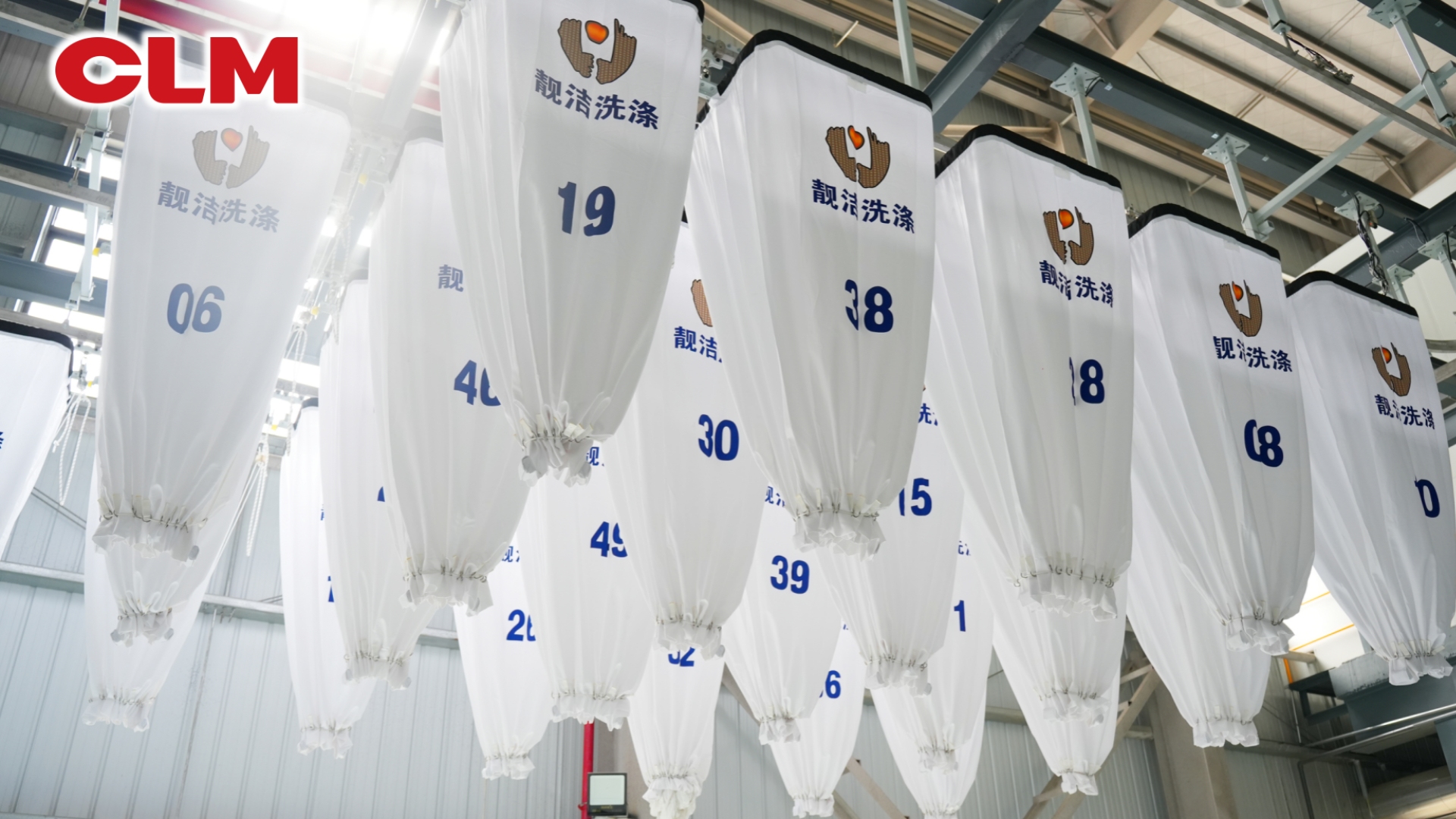
It uses a closed-loop overhead track system. Linens exiting the dryer are directly loaded into dedicated hanging bags. Each bag is an independent transport unit, and they are suspended on the track and automatically assigned by a central control system to designated workstations based on production status.
Throughout transport, linens are in a sealed environment and are isolated from the outside. This removes the risk of secondary contamination. The system also provides buffering capacity to balance production rhythm.
- Automatic pickup system
When a hanging bag reaches its designated position, its bottom automatically opens and releases linens into the pickup equipment hopper. The machine mechanically separates the linens and outputs them one by one. This completely solves the tangle issue.
- Conveyor line system
Separated linens are conveyed continuously to each spreading workstation. A buffer platform is provided at each station. This allows linens to naturally accumulate for easy retrieval. The conveyor height is ergonomically designed, so there is no need for operators to bend.
● Comprehensive effects
- Automatic pickup efficiency is far higher than that of manual operation.
- No unnecessary handling and waiting time.
- Reduces linen damage rate.
- Improves working environment and employee satisfaction.
This system is not just a combination of equipment, but a systemic restructuring of traditional processes. It transforms the ironing stage from labor-intensive to equipment-driven.
Pillowcase Storage and Feeding System
● Current bottleneck
Small items like pillowcases are severely wrinkled after washing, and the automatic flattening is difficult. They still heavily rely on manual sorting and separation, so the labor intensity is high.
● Solution
Laundry plants should build a pillowcase storage and feeding system, with a separate pillowcase ironing line. Washed pillowcases are collected into the system, where operators perform initial flattening and single-piece separation, then load them into a storage unit. The system continuously and automatically feeds them to the ironing equipment.
● Result
The continuous and automated processing of small items can be achieved. This greatly reduces the manual involvement and improves overall efficiency.
Automatic Folding, Sorting, and Identification System
● Current bottleneck
After folding, linens need to be sorted by customer. Manual sorting is inefficient, and it easily has errors.
● Solution
An REID identification system should be integrated at the back end of the folder. When linens pass through the reading area, the system automatically identifies them and controls the downstream sorting equipment to direct them to the correct customer-specific chute.
● Result
It can achieve high-speed, high-accuracy automatic sorting. The sorting efficiency can reach several thousand items per hour, and the accuracy rate is close to 100%.
Automatic Conveying, Storage, and Warehousing System
● Current Bottleneck
Finished linens are manually moved to storage. This causes low efficiency and chaotic warehouse management.
● Solution
Laundry plants should deploy AGVs or a conveyor system to connect the packing area with the warehouse.
● Result
It achieves automatic transport and storage. Synchronized inventory data updates support efficient dispatch.
Automatic Data-Driven Outbound System
● Current bottleneck
The outbound process relies on manual verification, which has low efficiency and easily has problems.
● Solution
Laundry plants should install an RFID reading system at the outbound exit. The system reads all package tags in batches, automatically generates an outbound manifest, and cross-checks it against transport orders.
● Result
It achieves automatic reading, automatic verification, and automatic generation of outbound data. Also, it ensures accuracy and real-time data synchronization.
Through these systematic upgrades, the laundry plant will achieve:
- full-process integration
- end-to-end data connectivity
- greatly improved automation
- a solid foundation for subsequent digital and intelligent upgrades
Post time: Apr-02-2026