
Travelling around China, it is easy to find a phenomenon that truly automated and systematically operational laundry factories are rare in China. Most laundry factories still stay in the phase of standalone machines or tunnel washer+ironing line. Although some equipment has achieved automation, tasks like handling, sorting, and transshipment still need a lot of labor. This is not an accidental phenomenon but a systematic problem that is caused by the industry ecosystem, technology, the market, and so on.
Control Dilemma
Who should lead the planning of the laundry factories?
● Laundry plant investors
The initiative for intelligent transformation lies first in the hands of the investors of laundry factories. But the real condition is that their thinking model is the first barrier to intelligence transformation.
Most bosses of laundry factories were sales representatives or managers before. Their success relies on the operation mode and cost structure. As a result, they easily use the local upgrade instead of the system reconstruction.
A simple example:
Many laundry plant bosses can see that the addition of one conveying line can reduce one staff member. However, few people imagine a complete system from an overall perspective. From the collection of soiled linen, automatic sorting, washing, drying, ironing, folding, storing, and delivering, the whole process is connected with an automatic logistics system and managed by the digital system together.
In addition, many investment decisions are still cost-oriented instead of efficiency-oriented. What investors pay more attention to is the availability of equipment and short-term cost savings. They care less about the long-term efficiency of the system and overall operational costs. As a result, they are more willing to invest in visible equipment, and they do not have enough value evaluation of the invisible process planning, system software, and overall design.
● Laundry equipment supplier
On the other hand, the equipment supplier still has obvious problems. Currently, many laundry equipment manufacturers in China are still trapped in the traditional mode of selling products.
With the development of the industry, more and more laundry plant bosses began to put forward the demand for intelligent laundry factories. However, many of them cannot clearly express what they truly want. The sales team also hasn’t completed the transformation from selling equipment to undertaking programs. After communication, the requirements of the laundry bosses that the sales representative bring back are still at the level of equipment: 2 tunnel washers and 4 ironing lines.
In this condition, even though the equipment is advanced, it is hard to build a truly intelligent laundry plant.
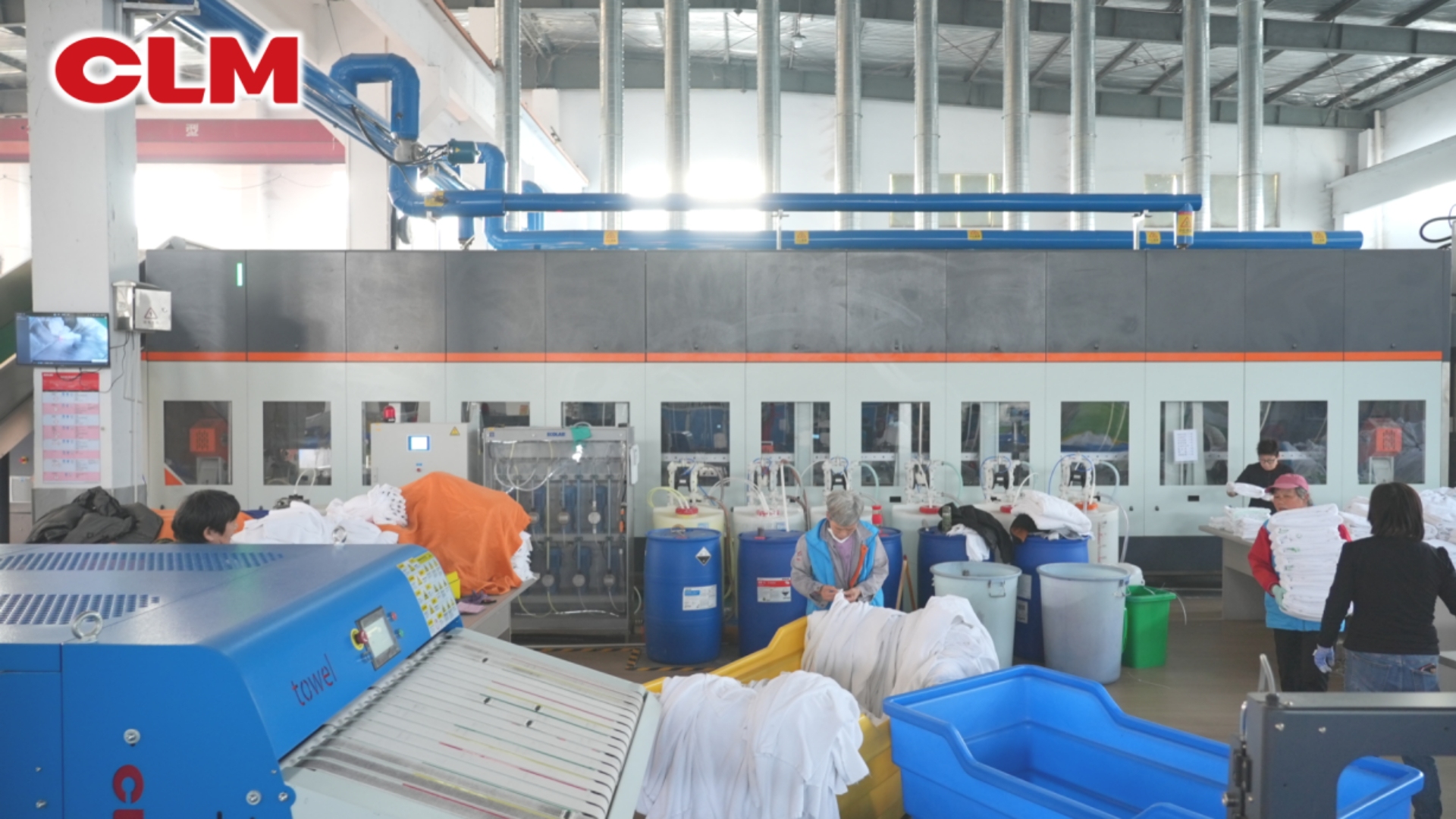
Just as General Manager Lu of CLM said, many equipment suppliers are used to providing what customers need. Though this passive mode can complete a deal, it hardly pushes the upgrade of the industry. The suppliers with real planning ability should play a role as the general planner. They should actively redesign the process, upgrade the system for the customers, and use a more advanced overall plan to convince customers.
Insufficient Planning and Systematic Integration Ability of Equipment Manufacturers
In a truly intelligent laundry plant, though the hardware equipment is important, the equipment itself only occupies a small part of the success factors. Generally speaking, the equipment is about 60%, and the overall planning, systematic planning is about 40%. Many equipment manufacturers have obvious shortages in the latter sector.
● Core Ability Structure
Many laundry equipment manufacturers’ advantages lie in machine manufacturing. They can produce tunnel washers, dryers, or ironing lines with great performance. However, in the industrial engineering, logistics planning, and software system integration fields, their labor is relatively insufficient.
This causes a problem in that a single piece of equipment is advanced, but the whole system cannot form a highly efficient, automated process. All pieces of equipment are just like isolated devices, lacking uniform logistics and information systems as connections.
● Insufficient development of auxiliary equipment
True intelligent laundry equipment not only relies on several core pieces of equipment, but it also needs a large number of auxiliary systems for support.
Automatic weighing system
Intelligent sorting equipment
Logistics conveying system
Multifunctional conveying line
AGV handling robot
Automatic packaging system
Data acquisition and control system
Although these pieces of equipment are not massive, they are the important links that connect the whole process. The current situation is that automation is forced to stop in some important links, and human labor is still needed in the end. As a result, the whole system cannot truly achieve continuous automation.
Post time: Mar-20-2026