
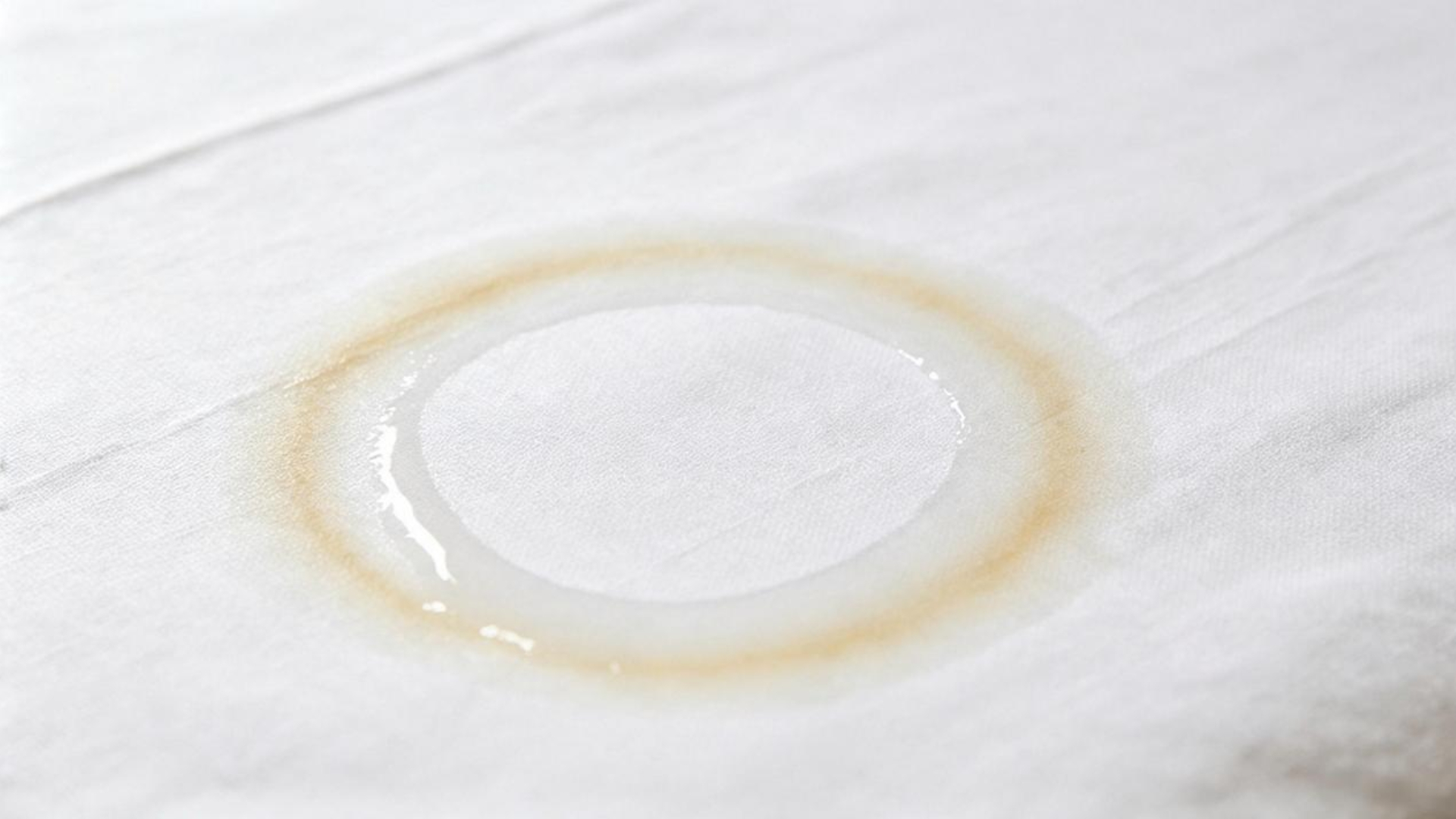
In large-scale commercial and industrial laundry operations, water ring stains often affect linen appearance. They can easily cause linen reprocessing and customer complaints, as well as increase business costs. Traditional manual stain removal mainly relies on operator experience. It heavily depends on operator skill and provides limited efficiency. It is difficult to meet the needs of large-scale standardized production.
Kingstar is a professional integrator of smart laundry plant systems. It focuses on automated equipment, such as tunnel washer systems, high-speed ironing lines, and smart overhead bag conveyor systems. Kingstar combines mature industry stain removal techniques with overall smart plant planning experience. It analyzes the core causes of water ring stains on linens and develops standardized solutions. Therefore, laundry businesses can improve quality, reduce costs, and upgrade their production processes.
Core Causes of Water Ring Stains
Most water ring stains are not just caused by improper drying. The core cause is moisture migration during localized stain treatment. Stains are affected by multiple factors (such as fabric types, textile structure, and cleaning methods). Residual impurities can be moved to the wet-dry boundary. They can form visible marks after moisture evaporates.
These stains become more obvious on special fabrics. Silk, synthetic fiber fabrics, and matte knitted linen contain water-soluble sizing agents. They can dissolve when coming into contact with liquid. This can cause localized loss of luster, forming water-stain-like stains. Damaged resin-coated fabrics (such as satin and taffeta) can generate spot-like water marks that are difficult to remove during laundry operations. Besides, moisture easily remains in layered-structure fabrics (such as quilted fabrics and down items). It slowly penetrates into fabric fibers. With residue buildup, this can lead to stubborn water ring stains on linens.
Standardized Cleaning Solutions
For different fabrics and causes of water stains, the industry has developed a mature, professional treatment system. It is suitable for the treatment of various commercial linens.
● Feathering technique
It applies to fresh water ring stains on regular linens. Dry steam can gently diffuse the edge of the water stain. Wipe the stained area from the inside outward with a dry towel. This can create a smooth transition between wet and dry areas. This can remove ring stains. For water-sensitive fabrics (such as silk), use a dry feathering process and a volatile dry solvent. This prevents fabric damage as well as improves blending results around seams.
● Rapid air-drying & vacuum extraction method
It is mainly used for fresh water ring stains that have not yet dried. Airflow and vacuum extraction equipment can quickly remove surface moisture as well as suspended impurities. By drying the stained area, this can prevent residue deposition at the source. Thus, it is an effective pre-treatment in high-volume laundry processes.
● Leveling agenttreatment
A specialized laundry leveling agent can refine water droplets and evenly distribute surface moisture. This can avoid localized moisture accumulation and spreading. It can also effectively prevent water stains caused by uneven moisture. This method is suitable for high-volume standardized laundry applications.
● Dedicated treatmentfor special fabrics
Damage to resin-coated fabrics can lead to stubborn water stains. After targeted treatment with amyl acetate, the stained area can be restored with dry cleaning. Quilted fabrics and down products are suitable for water cleaning and low-temperature drying processes. This can thoroughly remove residual moisture between the layers. Meanwhile, natural oils from down feathers can be removed. This avoids ring stains caused by secondary moisture migration.
Smart Equipment Prevention
The above traditional treatment methods are post-event measures. They are time-consuming and labor-intensive. They may also cause high rework rates. Repeated treatment can reduce linen service life. Thus, they cannot meet modern laundry plants’ large-scale and high-quality production requirements.
To remove water stains, the key is to address issues, including uneven wetting, extraction, drying, and linen transfer throughout the process. These issues can be addressed through standardized and smart equipment and processes. Kingstar provides complete equipment and workflow planning services. It helps remove water stains at the source.
● Solution 1
Residual moisture can cause water stains. For various fabric types, a tunnel washer system can set proper parameters. This achieves uniform wetting, stable extraction, and gradient temperature-controlled drying. Thus, localized water accumulation, moisture migration, and residue deposition can also be prevented. Besides, equipment parameters can be standardized and repeatable. Unlike manual operations, this reduces quality fluctuations as well as defect rework rates.
● Solution 2
Water marks may become more visible after drying. Fabric appearance turns dull. A high-speed ironing line features overall even heating and a gentle ironing process. It can effectively smooth out the surface water stains and restore uniform fabric luster. This system creates a closed loop between washing and drying processes. It prevents secondary water stains from developing. It also improves linen appearance after finishing.
● Solution 3
Improper manual handling may cause water marks. An overhead bag conveyor system helps prevent moisture retention that is often caused by stacking. Each batch of linen can maintain evenly dried and consistent conditions. This helps reduce water stain issues during linen transfer.
At the same time, Kingstar provides overall smart laundry plant planning and design services. Combined with clients’ production capacity, sites, and linen types, it integrates refined processes into the entire automated production line. Optimized equipment and processes help laundry plants reduce manual operations. Therefore, they can achieve standardized production, which is efficient, stable, and low-cost.
Q&A
Q1: Are frequent water ring stains on linens caused by improper operations or equipment?
A1: Many factors can lead to water stains (such as improper manual operations, temperature and water control, as well as drying). Smart equipment can control the process with standardized programs. This prevents water stains at the source.
Q2: Can water ring stains be removed in one way?
A2: No. The cleaning method depends on the fabric type. Regular fabrics require the feathering technique and leveling agent. Silk and resin-coated fabrics need dry processes and specialized solvents. Besides, moisture between layers can be removed from quilted fabrics as well as down items.
Q3: Can a smart laundry line prevent water stains?
A3: Yes. Complete smart equipment can achieve uniform wetting, precise extraction, temperature-controlled drying, and orderly linen transfer. It addresses issues (such as uneven moisture distribution and localized moisture retention) that cannot be avoided by manual operations. It further ensures stable linen quality in high-volume operations. Water stains and various linen defects are significantly reduced.
Post time: Sep-17-2026