
In the laundry industry, factories always struggle with high labor intensity, energy consumption, and efficiency bottlenecks. These core issues have restricted the development of laundry plants. During peak business periods, workers and equipment are tested to their limits. Zhengzhou Dinghong Laundry has been deeply involved in Henan’s laundry industry for nearly twenty years. Through a comprehensive smart transformation, it successfully turned these challenges into new growth drivers. It has proved that proper planning and advanced equipment not only improve capacity but also respect employee value.
Before Transformation
In the past, Dinghong faced challenges found in most traditional laundry plants. With a daily laundry volume of around 20 tons, the factory used a standalone machine and dryer model. Wet linen carts weighing over 100 kg needed to be manually transported to each workstation. In the finishing area, employees always needed to bend to handle linen. Due to a day of heavy physical labor, they were extremely tired. So, they were unable to address the surging holiday laundry demands. Meanwhile, traditional machines had high energy and water consumption. The residual moisture content of the washed linen remained high. This not only increased operating costs but also caused inefficient coordination between washing and finishing processes. The entire production efficiency was severely limited by labor and experience.
To address the above issues, Dinghong determined to perform a technical upgrade and facility redesign. The core logic of the upgrades is: replace manual transportation with automated conveying systems, replace experience with smart control, and replace fragmented operations with systematic design.
After Transformation
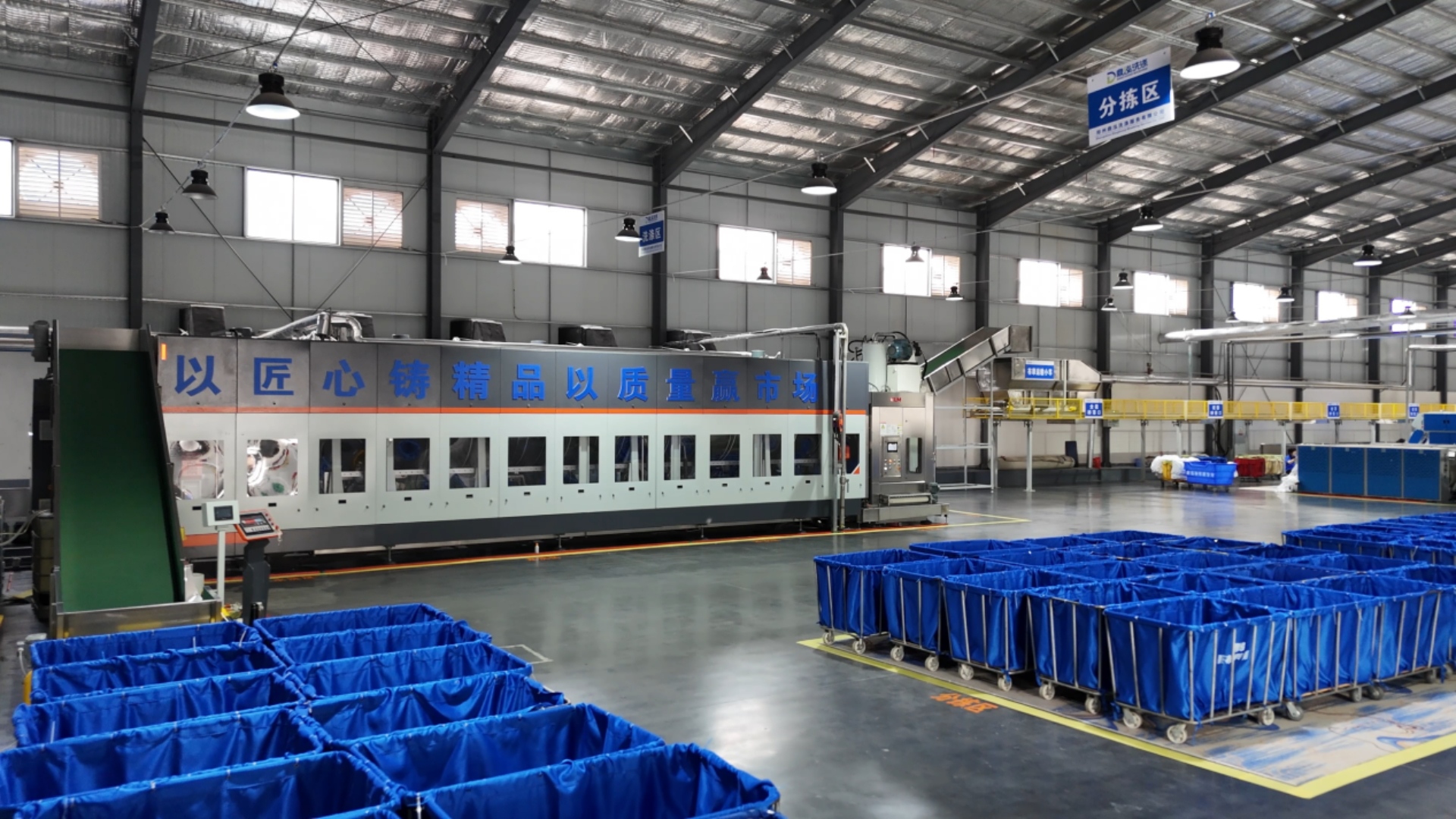
At present, the new Dinghong Laundry Plant uses Kingstar smart equipment, including a tunnel washer, three high-speed ironing lines, and two towel folders. With a scientific facility layout, it has achieved a complete workflow transformation from washing to finishing.
● Equipment upgrades
An overhead conveyor system connects all functional zones in the factory. After exiting the tunnel washer, wet linen is automatically transferred to the dryer by a shuttle conveyor. This completely eliminates manual handling. After drying, linen is automatically conveyed to the folding area. Kingstar towel folders require workers only to place towels on the feeding platform. They can automatically identify sizes, achieving sorting, folding, and stacking. After being separated, bed sheets and duvet covers are conveyed to each finishing workstation.
Dinghong Laundry combines the elevated shuttle conveyor with the discharge opening. There is a discharge opening behind each finishing workstation. Linen drops onto the conveyor belts before being transferred to workstations. The conveyor height is ergonomically designed. Workers can reach linen naturally without frequent bending. This change reduces workers’ high labor intensity. Their workplace comfort has been significantly improved.
● Energy consumption optimization
A traditional standalone machine consumes up to 20 kg of water per kilogram of linen. However, the Kingstar tunnel washer is equipped with an advanced water reuse system. This figure can be reduced to about 5 kg, only one quarter of the original consumption. At the same time, the tunnel washer uses a press extraction technology. After extraction, the residual moisture content in linen is much lower than that in traditional machines. This significantly reduces the following drying energy consumption. Take the Kingstar steam-heated pass-through dryer as an example. Drying 120 kg of towels only requires 100-140 kg of steam. Its energy-efficiency effect is noticeable.
Due to low residual moisture content, bed sheets and duvet covers do not require pre-drying. They can directly enter the high-speed ironing line. The ironing speed can reach up to 60 m/min. This system achieves continuous production, including drying, ironing, shaping, and folding. It provides better ironing performance. The entire tunnel washer system efficiently processes 1.8 tons of linen per hour. The washing process matches the finishing stage. This thoroughly addresses waiting and transfer bottlenecks under the traditional model. It ensures continuous production.
● Improved working environment
Besides equipment and process upgrades, Dinghong also focuses on employees’ working environment. After transformation, the factory greatly reduces the use of linen carts. The workshop becomes cleaner and more orderly. Facing high temperatures in summer, the factory adds thermal insulation layers to its roof. It combines air coolers and negative pressure ventilation fans for forced cooling. What’s more, Kingstar performs professional thermal insulation treatment on heat-generating components, such as cabinets, door panels, and steam pipes. This effectively reduces heat dissipation. In summer, this creates a more comfortable working environment for employees.
Conclusion
This upgrade has delivered immediate results for Dinghong Laundry. Under the same workload, the number of required workers and working time are reduced. But the overall operating efficiency greatly improves. Dinghong has reserved space for the second tunnel washer. It has prepared for future capacity expansion.
The case of Zhengzhou Dinghong Laundry shows that the upgrade of a laundry plant is not about adding more equipment, but a systematic project around people and efficiency. With smart equipment and human-centred design, a laundry plant can reduce labor intensity and improve the working environment. It can also improve energy efficiency and productivity. This is not only the choice of Dinghong but also a development trend of modern laundry plants.
Q&A
Q1: What is the laundry volume of Dinghong Laundry?
A1: During the off-season, its daily laundry volume is around 5,000 sets.
Q2: What is the area of this laundry plant?
A2: More than 3,000 square meters.
Q3: Can Kingstar provide upgrade solutions for old factories?
A3: Yes. Kingstar has more than twenty years of experience. It can provide a large number of cases for reference.
Post time: Aug-28-2026