
We must be clear that every efficiency revolution in the laundry industry has not been driven spontaneously by laundry operators, but by equipment manufacturers. For this reason, equipment companies must complete a three-stage role transformation.
The Way Forward
Equipment Supplier → System Solution Provider → Intelligent Chief Planner.
This shift is not a slogan, but a restructuring of organizational capabilities and methodologies.
● Change the mindset
In the traditional model, we are used to doing what the customer asks for. But in the era of intelligence, such passive responses cannot support the implementation of complex systems. We must shift from an executor to a definer.
– Build a cross-disciplinary planning team
Mechanical engineers, electrical engineers, software engineers, and industry experts with in-depth laundry process expertise (sales roles will no longer be just sales, but process consultants).
– Shift from receiving requirements to making diagnostics
Instead of simply asking customers what they want to achieve, laundry equipment manufacturers should use research and analysis to clearly tell them where their problems lie, what they should do, and how they should do it.
● Process reconstruction
The essence of an intelligent laundry factory is not equipment upgrades. It is a process redesign. We need to go deep into workshop floors to systematically identify three key types of waste.
– Logistics waste: repeated linen handling, redundant routing
– Labor waste: worker idle time, low-value repetitive tasks
– Process waste: discontinuous production, workflow bottlenecks
Based on this, we should restructure operations through systematic solutions:
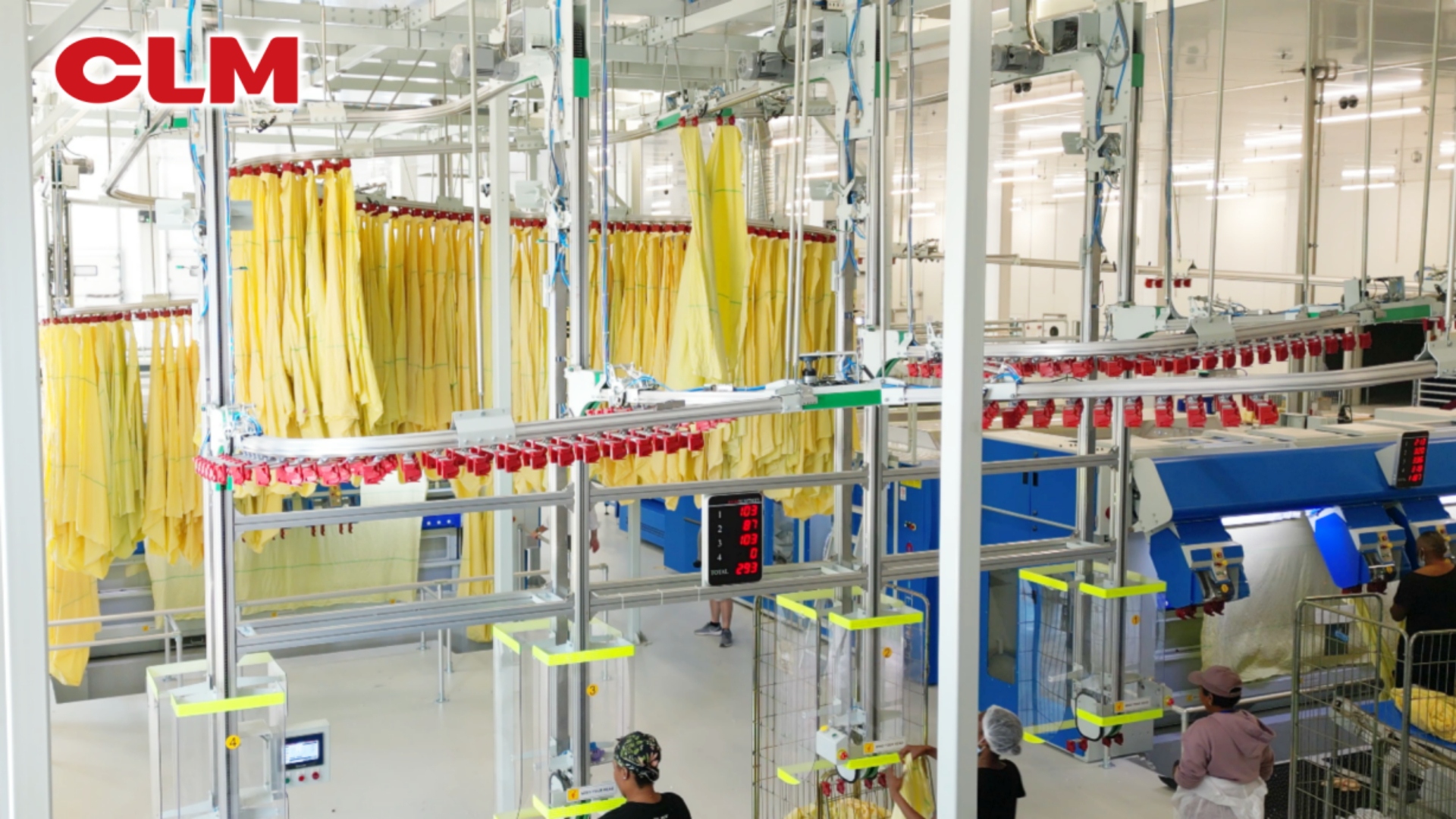
– Automatic sorting systems
– Hanging bag systems
– Conveyor line systems
– Picking machines
– Finishing and sorting systems
– Automatic packing and warehousing systems
Core goal:
This keeps linen flowing and turns workers from movers into supervisors. Finally, a customized intelligent laundry factory can be built.
● Whole-Factory Integrated Solutions
Future customers will no longer need individual pieces of equipment, but a complete, operable, and simulatable factory system blueprint. The factory should cover at least three core pillars.
– Seamless logistics system
From soiled linen receiving to clean linen delivery, continuity should be full-process. Linen never touches the ground or flows backward. This reduces unnecessary manual handling as much as possible.
– Data-driven information flow
Using QR codes, RFID, and other technologies to enable:
– Trackable location for every batch of linen
– Monitorable status for every process step
– Recordable parameters for every operation
Finally realizing full-process visualization and traceability.
– Human-machine collaboration System
Assign workers to high-value positions:
front-end sorting decisions
finishing quality control
packing and distribution management
while leaving all repetitive and heavy physical work to automated systems.
● Market education
The biggest barrier to intelligent upgrading is never technology, but trust.
We must therefore build two persuasive systems:
– Benchmark
Develop visitable, experience-enabled low-staff / unmanned workshops.
– Data-Driven ROI Models
Speak with real operational data, for example:
Labor cost reduction: 80%–90%
Energy consumption reduction: approx. 20%
Capacity improvement: approx. 30%
Space utilization improvement: approx. 30%
Let customers clearly see:
This is not a cost, but a high-certainty investment.
Phased Implementation Path
In the Chinese market, the biggest practical constraint on advancing intelligence is the too-high upfront investment. We must therefore design phased, evolvable upgrade paths for customers:
● Phase 1: Basic Automation
The goal is to simplify workflows and remove critical bottlenecks. Laundries should first introduce hang bag systems, conveyor lines, linen sorting systems, and finishing (folding / packing / warehousing) systems to achieve non-touch linen handling and continuous workflows. This greatly reduces manual handling.
● Phase 2: Digitalization
The goal is to make factory operations visible. This needs a central control platform and sensor systems to collect key data on energy use, efficiency, and working hours. This helps real-time process monitoring, visualized laundry management, and preliminary data analysis.
● Phase 3: Intelligence
The goal is to equip the system with decision-making capabilities. This needs introducing RFID, AI visual recognition, intelligent production scheduling, and predictive maintenance systems to enable intelligent management.
● Phase 4: Full-Process Unmanned Operation
The goal is to evolve from smart factories to smart ecosystems. By integrating hotel-side systems, building automated settlement systems, and unmanned linen receiving and delivery, we close the loop on full digitalization and unmanned operation across the entire linen flow.
Conclusion
The implementation of intelligent digital laundry factories is never a one-step technological upgrade, but a systematic restructuring around processes, organizations, and mindsets.
If equipment manufacturers cannot become chief planners, intelligence will forever be superficial as mere equipment automation. Once this role transformation is complete, what we deliver will no longer be equipment, but a continuously evolving production system.
Post time: Apr-16-2026